Quantum Computing Race: 3 U.S. Startups Promising by 2025

Anúncios
The quantum computing race is accelerating, with three innovative U.S. startups promising significant breakthroughs by 2025, aiming to unlock unprecedented computational power for complex global challenges.
The quantum computing race is not just a theoretical pursuit; it’s a fiercely competitive arena where cutting-edge innovation promises to redefine industries. By 2025, three U.S. startups are poised to deliver on ambitious promises, potentially shifting the paradigm of computational power as we know it. What exactly are these companies bringing to the table, and how might their advancements impact our world?
Anúncios
The Quantum Landscape: A Primer on Revolutionary Computing
Quantum computing represents a fundamental shift from classical computing, leveraging the principles of quantum mechanics to process information in radically new ways. Unlike traditional bits that can only be 0 or 1, quantum bits, or qubits, can exist in multiple states simultaneously through superposition, and can also be entangled, allowing for exponentially greater computational power. This capability opens doors to solving problems currently intractable for even the most powerful supercomputers, from drug discovery and material science to financial modeling and artificial intelligence.
The journey to commercial quantum computers is fraught with significant engineering and scientific challenges. Maintaining the delicate quantum states of qubits requires extreme isolation and precise control, often at temperatures colder than deep space. Despite these hurdles, progress has been rapid, fueled by substantial investments from governments, tech giants, and a burgeoning ecosystem of innovative startups. The U.S. has emerged as a particularly fertile ground for quantum innovation, with a strong academic foundation and robust venture capital support.
Anúncios
Understanding the basic principles is crucial to appreciating the promises these startups are making. Their innovations often lie in novel qubit architectures, improved error correction, or more scalable designs. Each approach has its own set of advantages and disadvantages, and the race is on to find the most robust and practical path to fault-tolerant quantum computing.
The foundational principles of quantum mechanics
- Superposition: Qubits can exist in multiple states (0 and 1) simultaneously, unlike classical bits.
- Entanglement: Qubits can become linked, so the state of one instantly influences the state of another, regardless of distance.
- Interference: Quantum states can constructively or destructively interfere, allowing for efficient problem-solving.
The potential applications are vast and transformative, touching almost every sector. From developing new catalysts to optimizing global logistics, quantum computers could provide solutions that are currently beyond our reach, making the progress of these startups a matter of global significance. The next few years will be critical in determining which technologies will lead the charge.
Startup Spotlight: Company A’s Superconducting Breakthroughs
Our first deep dive takes us to Company A, a U.S. startup that has been quietly making waves with its innovative approach to superconducting qubits. This technology, similar to that used by industry giants like IBM and Google, relies on circuits cooled to near absolute zero to achieve quantum states. Company A, however, claims to have made significant advancements in qubit coherence times and error rates, two critical metrics for quantum computer performance.
By 2025, Company A promises to unveil a quantum processor with unprecedented stability and a higher number of functional, interconnected qubits. Their proprietary fabrication techniques are reportedly reducing imperfections that typically lead to decoherence, allowing qubits to maintain their quantum states for longer periods. This improvement is vital for running complex algorithms that require many computational steps.
Industry insiders suggest Company A’s roadmap includes a modular design, enabling them to scale their quantum processors more effectively than current monolithic architectures. This modularity could pave the way for practical quantum computers with hundreds, if not thousands, of qubits, moving beyond the noisy intermediate-scale quantum (NISQ) era. Such a development would be a game-changer, opening up new avenues for quantum algorithm development and real-world applications.
Enhancing superconducting qubit performance
- Increased coherence times: Longer periods for qubits to maintain their quantum states.
- Reduced error rates: Fewer computational errors, leading to more reliable results.
- Scalable architecture: Modular designs for easier expansion and larger qubit counts.
The potential impact of Company A’s advancements is profound. Improved superconducting qubits could accelerate breakthroughs in materials science, leading to the creation of new superconductors or more efficient batteries. In finance, complex optimization problems could be tackled with greater precision, yielding better risk models and investment strategies. Their progress is being closely watched by the entire quantum community.
Startup Spotlight: Company B’s Trapped-Ion Precision
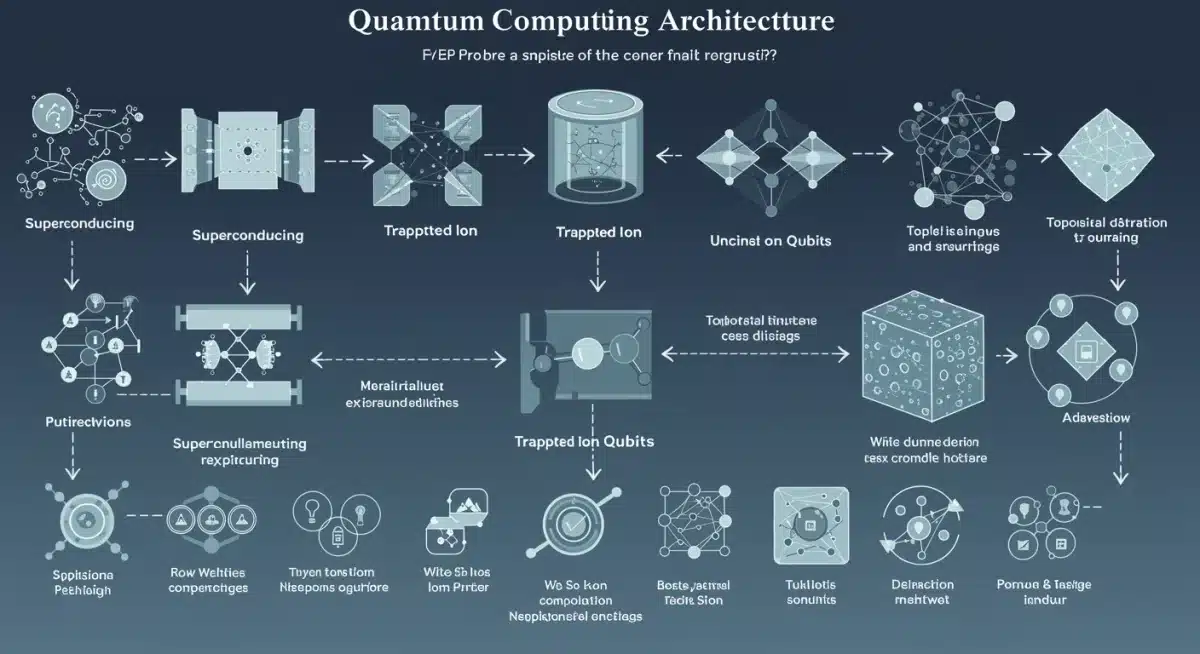
Company B represents a different, yet equally promising, facet of the quantum computing race: trapped-ion technology. This method uses electromagnetic fields to suspend individual ions, which act as qubits. Lasers are then used to manipulate the ions, creating highly precise and stable quantum gates. Historically, trapped-ion systems have boasted the highest fidelity (lowest error rates) among all quantum computing modalities, making them ideal for certain types of quantum algorithms.
What sets Company B apart is their innovative approach to scaling trapped-ion systems. While trapped-ion qubits are known for their excellent performance, building large-scale systems with many interconnected ions has been a significant challenge. Company B claims to have developed a novel architecture that allows for the integration of many ion traps on a single chip, effectively creating a ‘quantum internet’ on a smaller scale, where information can be reliably shuffled between different processing units.
By 2025, Company B aims to demonstrate a multi-core trapped-ion quantum computer capable of executing complex algorithms with significantly reduced communication overhead between qubits. This breakthrough could address one of the primary limitations of trapped-ion systems, making them competitive for a broader range of applications. Their focus on precision and connectivity could make them a frontrunner in quantum simulation and cryptography.
The implications of such precision are enormous. In the pharmaceutical industry, trapped-ion computers could simulate molecular interactions with unprecedented accuracy, accelerating drug discovery and development. For national security, enhanced cryptographic capabilities could protect sensitive information from future quantum attacks. Company B’s dedication to engineering excellence in trapped-ion systems positions them as a key player.
Startup Spotlight: Company C’s Novel Photonic Quantum Computing
Diverging from both superconducting and trapped-ion approaches, Company C is championing photonic quantum computing, a method that uses photons (particles of light) as qubits. This technology offers several inherent advantages, including room-temperature operation, which significantly reduces the complex cooling infrastructure required by other modalities, and the potential for seamless integration with existing fiber optic communication networks.
Company C’s innovation lies in its ability to generate, manipulate, and detect single photons with high efficiency and fidelity on integrated silicon chips. Their promise for 2025 includes a compact, scalable photonic quantum computer that can perform specific quantum tasks much faster than classical computers. They are focusing on applications where high-speed data processing and network integration are paramount, such as secure communication and distributed quantum computing.
The challenge with photonic quantum computing has traditionally been the probabilistic nature of photon interactions, making it difficult to build deterministic quantum gates. Company C, however, claims to have overcome some of these limitations through advanced optical engineering and novel quantum light sources. Their strategy involves building specialized quantum accelerators rather than general-purpose quantum computers, targeting specific high-value problems first.
Advantages of photonic quantum computing
- Room-temperature operation: Eliminates the need for expensive cryogenic cooling.
- Network integration: Compatible with existing optical fiber infrastructure for quantum communication.
- Scalability potential: Integrated photonics allow for compact and potentially large-scale systems.
The breakthroughs from Company C could revolutionize secure communication, offering truly unhackable networks based on quantum key distribution. Furthermore, their technology could enable distributed quantum computing, where multiple quantum processors work together over a network, vastly expanding computational capabilities. Their unique perspective on quantum hardware makes them a compelling contender in the race.
Challenges and the Road Ahead for U.S. Quantum Startups
While the promises made by these U.S. startups are incredibly exciting, the path to widespread quantum computing remains challenging. All three companies, regardless of their chosen modality, face common hurdles that must be overcome by 2025 and beyond. One of the most significant is error correction. Quantum systems are inherently fragile, and errors accumulate rapidly, making it difficult to maintain coherence for long enough to perform meaningful computations. Developing robust error-correction codes and fault-tolerant architectures is paramount.
Another major challenge is scalability. Building a quantum computer with a handful of qubits is one thing; scaling it to hundreds or thousands of interconnected, high-fidelity qubits is an entirely different engineering feat. This requires advancements in manufacturing, control systems, and software. The infrastructure required to support these complex machines also poses a significant hurdle, demanding specialized facilities and highly skilled personnel.
Furthermore, the development of practical quantum algorithms is still in its nascent stages. While theoretical algorithms exist, translating them into real-world applications that demonstrate a clear quantum advantage requires deep collaboration between quantum hardware engineers and software developers. The talent pool for quantum computing, though growing, is still relatively small, creating a bottleneck for rapid innovation.
Key challenges facing quantum computing development
- Error correction: Mitigating the inherent fragility and error accumulation in quantum systems.
- Scalability: Expanding qubit count while maintaining high fidelity and connectivity.
- Algorithmic development: Translating theoretical quantum algorithms into practical applications.
- Talent acquisition: Addressing the shortage of skilled quantum engineers and scientists.
Despite these formidable challenges, the rapid pace of innovation suggests that significant progress will indeed be made by 2025. Government funding, private investment, and intense competition are all driving forces accelerating research and development. The collective efforts of these startups, alongside established players, are pushing the boundaries of what is possible, making the future of computing exceptionally bright.
The Impact and Future of Quantum Computing by 2025
The promises made by these three U.S. quantum computing startups for 2025 are not just incremental improvements; they represent potential inflection points in the development of this transformative technology. If they deliver on their ambitious goals, the impact could be felt across numerous industries, ushering in an era of unprecedented computational capability. The ability to solve currently intractable problems could unlock billions, if not trillions, in economic value.
By 2025, we might see quantum computers moving beyond pure research labs into more specialized commercial applications, particularly in areas like quantum chemistry, materials science, and financial modeling. While general-purpose, fault-tolerant quantum computers are still likely a decade or more away, the targeted advancements from these startups could provide ‘quantum advantage’ for specific, high-value problems, demonstrating the tangible benefits of this new computing paradigm.
Moreover, the competition among these startups and larger tech companies is fostering a dynamic ecosystem of innovation. This environment is not only accelerating hardware development but also driving advancements in quantum software, programming tools, and educational initiatives. The next few years will be crucial in determining which quantum modalities and companies will emerge as leaders, shaping the trajectory of the entire field.
The long-term vision includes a future where quantum computers work in tandem with classical supercomputers, forming hybrid systems that tackle the most complex challenges facing humanity. From climate modeling to personalized medicine, the contributions of these pioneering U.S. startups will be instrumental in realizing that vision. Their ambitious targets for 2025 are a clear indication that the quantum era is rapidly approaching.
| Key Aspect | Description |
|---|---|
| Superconducting Qubits | Company A aims for improved coherence and scalability by 2025. |
| Trapped-Ion Technology | Company B focuses on high-fidelity, scalable multi-core systems. |
| Photonic Quantum Computing | Company C promises compact, room-temperature systems for specific tasks. |
| Key Challenges | Error correction, scalability, and algorithm development remain significant hurdles. |
Frequently Asked Questions About Quantum Computing Startups
Quantum computing utilizes quantum-mechanical phenomena like superposition and entanglement to process information. Unlike classical computers that use bits as 0s or 1s, quantum computers use qubits, which can represent 0, 1, or both simultaneously, allowing for exponentially greater processing power for specific problems.
The primary technologies include superconducting qubits (used by Company A), trapped ions (Company B), and photonic quantum computing (Company C). Other approaches involve neutral atoms, topological qubits, and quantum dots, each with unique advantages and engineering challenges.
Quantum computers excel at problems involving complex simulations, such as drug discovery, materials science, and financial modeling. They can also break certain cryptographic codes and optimize logistics or artificial intelligence algorithms that are currently intractable for classical machines.
Key challenges include achieving higher qubit coherence times, reducing error rates (error correction), scaling systems to a larger number of qubits, and developing practical quantum algorithms that demonstrate a clear ‘quantum advantage’ over classical methods for real-world applications.
In finance, quantum computers could optimize portfolio management and risk assessment. In healthcare, they could accelerate drug discovery, personalized medicine, and protein folding simulations. Their breakthroughs could lead to more efficient systems and novel solutions across various sectors.
Conclusion
The quantum computing race is undeniably accelerating, driven by the ambitious promises of innovative U.S. startups like Company A, B, and C. Their diverse approaches—superconducting, trapped-ion, and photonic—each offer unique pathways to unlocking the immense potential of quantum computation. While significant hurdles in error correction, scalability, and algorithm development remain, the rapid pace of progress indicates that by 2025, we are likely to witness pivotal advancements. These breakthroughs will not only push the boundaries of technology but also lay the groundwork for a future where previously unsolvable problems become tractable, profoundly impacting industries and society at large.