Boosting Digital Accessibility by 20%: US Websites 2026 Standards
Anúncios
Achieving a 20% boost in digital accessibility for US websites by 2026 requires a proactive, step-by-step approach focusing on WCAG guidelines, legal compliance, and user-centric design to ensure inclusivity.
Boosting Digital Accessibility by 20%: A Step-by-Step Guide for US Websites to Meet 2026 Standards is not merely a compliance checklist; it’s a strategic imperative for any US website aiming for broader reach and enhanced user experience. As digital landscapes evolve, ensuring that all users, regardless of ability, can access and interact with online content becomes paramount. This guide outlines the essential steps to navigate the evolving regulatory environment and achieve significant accessibility improvements.
Anúncios
Understanding the Mandate: Why 2026 Matters for Digital Accessibility
The year 2026 marks a crucial point for digital accessibility in the United States. While specific new legislation is always on the horizon, the underlying expectation is a heightened enforcement of existing laws like the Americans with Disabilities Act (ADA) and Section 508 of the Rehabilitation Act, alongside a stronger emphasis on Web Content Accessibility Guidelines (WCAG). Businesses must prepare for a landscape where accessibility is no longer an afterthought but a fundamental aspect of web development and design.
Ignoring these standards carries significant risks, ranging from costly lawsuits to reputational damage and the alienation of a substantial user base. Conversely, proactive engagement with accessibility not only ensures legal compliance but also unlocks new market segments and fosters a more inclusive brand image. The push for a 20% accessibility boost by 2026 is a call to action for incremental, yet impactful, improvements.
Anúncios
The Legal Framework: ADA, Section 508, and Beyond
Understanding the legal landscape is the first step toward effective compliance. These regulations provide the foundation for digital accessibility requirements in the US.
- Americans with Disabilities Act (ADA): While originally enacted in 1990 for physical spaces, courts have increasingly applied ADA Title III to websites and mobile applications, viewing them as places of public accommodation.
- Section 508 of the Rehabilitation Act: This applies specifically to federal agencies and organizations receiving federal funding, requiring them to make their electronic and information technology accessible to people with disabilities.
- State and Local Laws: Many states and municipalities have their own accessibility mandates that can supplement federal requirements, adding layers of complexity and scope.
Navigating this legal maze requires careful attention to detail and an understanding that interpretations can evolve. The goal is to move beyond minimal compliance towards truly inclusive design principles. This proactive approach helps mitigate risks and future-proof digital assets against potential legal challenges.
In essence, the 2026 deadline represents a convergence of legal pressure, ethical responsibility, and strategic advantage. Companies that embrace digital accessibility now will be well-positioned for future success, demonstrating a commitment to all their users.
Establishing Your Baseline: The Initial Accessibility Audit
Before embarking on any improvements, it is essential to understand your current accessibility posture. An initial accessibility audit serves as a diagnostic tool, identifying existing barriers and establishing a clear baseline against which future progress can be measured. This comprehensive assessment should cover both automated checks and manual testing to provide a holistic view of your website’s compliance.
Without a thorough audit, efforts to improve accessibility can be misdirected, leading to wasted resources and incomplete solutions. A well-executed audit provides a roadmap, highlighting critical areas that require immediate attention and outlining a strategic plan for long-term enhancements.
Automated vs. Manual Testing: A Balanced Approach
Effective auditing combines the speed of automated tools with the nuanced insights of manual review.
- Automated Accessibility Tools: These tools can quickly scan large websites for common accessibility issues, such as missing alt text, insufficient color contrast, or incorrect heading structures. They are excellent for identifying low-hanging fruit and providing a broad overview.
- Manual Accessibility Testing: Crucially, manual testing involves human evaluators, often including individuals with disabilities, who navigate the website using assistive technologies like screen readers, keyboard navigation, and voice control. This uncovers complex issues that automated tools cannot detect, such as logical reading order, clear link context, and overall user experience for people with disabilities.
- User Testing with Disabled Individuals: Directly involving users with disabilities in the testing process is invaluable. Their feedback provides authentic insights into real-world challenges and helps prioritize fixes based on actual user impact.
By combining these methods, organizations can gain a comprehensive understanding of their website’s strengths and weaknesses regarding accessibility. The audit report should clearly document all identified issues, their severity, and recommendations for remediation, providing a solid foundation for your digital accessibility standards US initiative.
Strategic Implementation: Prioritizing and Remediation
Once the audit is complete, the next critical phase is strategic implementation. This involves prioritizing identified issues, developing a clear remediation plan, and integrating accessibility fixes into your existing development workflows. The goal is to address the most impactful barriers first, ensuring that your efforts yield noticeable improvements for users with disabilities.
Effective prioritization is key to achieving the 20% boost in accessibility by 2026 without overwhelming resources. Not all issues carry the same weight; some have a far greater impact on user experience and legal compliance than others.
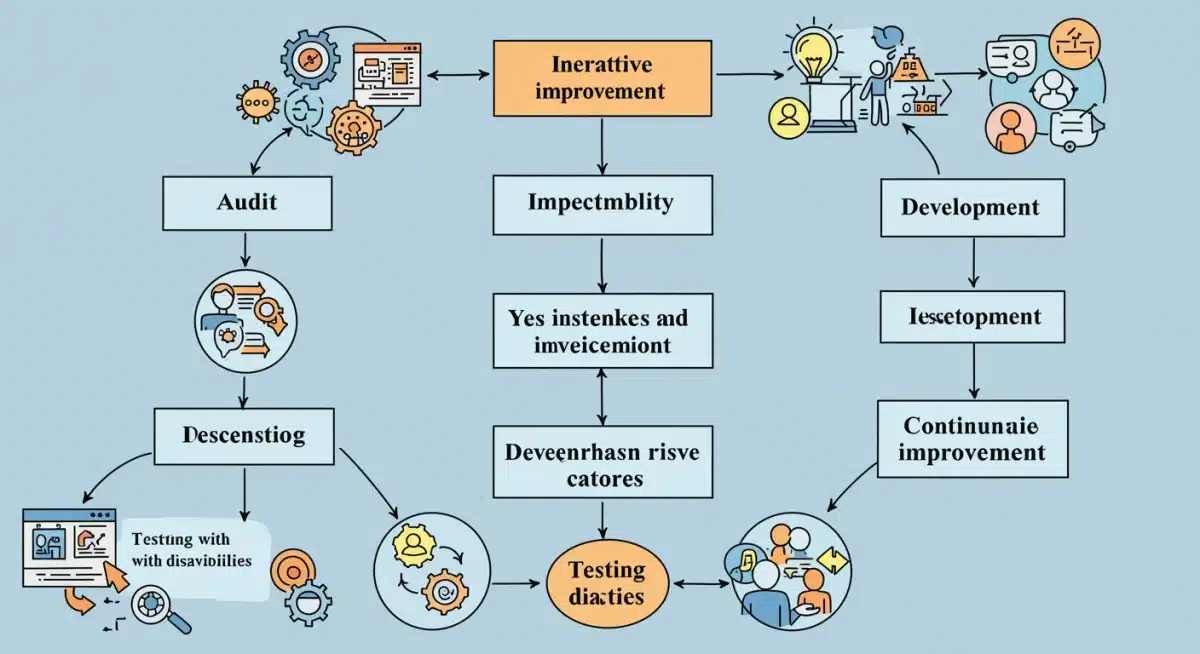
Developing a Remediation Roadmap
A well-defined roadmap guides your team through the remediation process efficiently.
- Severity and Impact Assessment: Categorize issues based on their severity (e.g., critical, major, minor) and their impact on user experience for different disability groups. Critical issues, such as inaccessible navigation or forms, should always take precedence.
- WCAG Compliance Levels: Align remediation efforts with WCAG 2.1 or 2.2 guidelines, aiming for at least AA conformance. This provides a measurable target for your accessibility improvements.
- Iterative Improvements: Break down large accessibility projects into smaller, manageable tasks. An iterative approach allows for continuous progress and easier integration into agile development cycles.
Integrating accessibility into the development lifecycle is crucial. This means that new features and content should be designed and developed with accessibility in mind from the outset, rather than trying to retrofit it later. By making accessibility a standard part of your workflow, you ensure sustained compliance and reduce future remediation costs. This proactive stance is fundamental for meeting digital accessibility standards US by 2026.
Ultimately, strategic implementation is about moving from identification to action. By carefully prioritizing issues and integrating accessibility into your core processes, you can make significant strides toward a more inclusive digital presence.
Training and Culture: Fostering an Accessibility-First Mindset
Achieving and maintaining digital accessibility is not solely a technical endeavor; it requires a fundamental shift in organizational culture. Fostering an accessibility-first mindset across all teams—from design and development to content creation and quality assurance—is crucial for long-term success. This involves comprehensive training, clear communication of accessibility goals, and leadership buy-in.
Without a strong cultural foundation, even the most robust technical solutions can fall short. An organization where every team member understands their role in creating accessible experiences is one that will consistently meet and exceed accessibility standards.
Comprehensive Training Programs
Investing in training is paramount. Different roles require different levels of accessibility knowledge.
- Designers: Should be trained on inclusive design principles, color contrast, typography, and clear visual hierarchy.
- Developers: Need to understand semantic HTML, ARIA attributes, keyboard operability, and accessibility testing tools.
- Content Creators: Must learn how to write effective alt text for images, create meaningful link text, structure content with headings, and use plain language.
- Project Managers: Should be able to integrate accessibility requirements into project timelines and budgets, ensuring it’s a priority from conception.
Regular refreshers and updates to training materials ensure that teams stay current with evolving WCAG guidelines and best practices. This continuous learning environment reinforces the importance of accessibility.
Furthermore, leadership must champion accessibility, communicating its value not just in terms of compliance but as a core business objective that enhances user experience and expands market reach. When accessibility is embedded in the company’s values, it becomes a natural part of every decision-making process, driving sustainable improvements towards digital accessibility standards US.
Continuous Monitoring and User Feedback Loops
Digital accessibility is not a one-time project but an ongoing commitment. Websites are dynamic entities, constantly updated with new content, features, and design elements. Therefore, continuous monitoring and the establishment of robust user feedback loops are essential to maintain compliance and ensure a consistently accessible experience. This proactive approach helps catch new issues before they become significant barriers and demonstrates a genuine dedication to inclusivity.
Regular checks and the ability to respond swiftly to user input are vital for any organization committed to excellence in digital accessibility.
Implementing Regular Accessibility Checks
Scheduled and automated checks play a significant role in maintaining accessibility.
- Automated Scans: Schedule periodic automated scans of your entire website or specific sections, especially after major updates or content additions. These tools can alert you to regressions or newly introduced issues.
- Manual Spot Checks: Conduct regular manual spot checks on critical user flows (e.g., login, checkout, search) to ensure they remain accessible with assistive technologies.
- Accessibility in QA: Integrate accessibility testing into your standard Quality Assurance (QA) process. Every new feature or content update should undergo accessibility review before deployment.
Beyond internal checks, actively soliciting and responding to user feedback is paramount. Providing a clear and accessible mechanism for users to report accessibility barriers empowers them to contribute to your ongoing improvement efforts. This could be a dedicated accessibility statement with contact information, a feedback form, or direct email. Engaging with users with disabilities offers invaluable insights that automated tools or internal testing might miss, ensuring that your website truly serves its diverse audience and continues to meet digital accessibility standards US.
Future-Proofing Your Website: Beyond 2026 Compliance
While the immediate goal is to achieve a 20% boost in digital accessibility and meet 2026 standards, forward-thinking organizations should look beyond mere compliance. Future-proofing your website involves adopting a mindset of progressive enhancement, anticipating evolving accessibility technologies, and embracing universal design principles. This strategic vision ensures that your digital assets remain accessible and relevant in an ever-changing technological landscape.
By building a foundation of inclusive design, you prepare your website not just for the next set of regulations, but for the diverse needs of all users for years to come.
Embracing Universal Design Principles
Universal design is about creating products and environments usable by all people, to the greatest extent possible, without the need for adaptation or specialized design. For websites, this translates into:
- Perceivable: Information and user interface components are presentable to users in ways they can perceive.
- Operable: User interface components and navigation are operable.
- Understandable: Information and the operation of user interface are understandable.
- Robust: Content is robust enough that it can be interpreted reliably by a wide variety of user agents, including assistive technologies.
Investing in technologies that inherently support accessibility, such as semantic HTML5, well-structured CSS, and progressive web applications (PWAs), can significantly reduce future remediation efforts. Staying informed about emerging assistive technologies and web standards will also help you adapt quickly to new requirements. By embedding accessibility into the very fabric of your website’s design and development, you not only meet current digital accessibility standards US but also build a resilient and inclusive digital presence that benefits everyone.
Ultimately, future-proofing is about recognizing that accessibility is an investment in your user base and your brand’s longevity. It’s about designing for humanity, ensuring that everyone has equal access to information and opportunities online.
| Key Aspect | Brief Description |
|---|---|
| Initial Audit | Assess current website accessibility using automated and manual testing to identify barriers. |
| Remediation Plan | Prioritize and fix accessibility issues, integrating WCAG guidelines into development. |
| Training & Culture | Educate teams on accessibility best practices to foster an inclusive design mindset. |
| Continuous Monitoring | Implement regular checks and user feedback loops for ongoing accessibility maintenance. |
Frequently Asked Questions About Digital Accessibility
The primary goals include enhancing user experience for individuals with disabilities, ensuring legal compliance with ADA and Section 508, expanding market reach, and fostering an inclusive brand image. The 20% target emphasizes measurable, impactful improvements over a short period.
For US websites, the most relevant standards are the Web Content Accessibility Guidelines (WCAG), typically WCAG 2.1 or 2.2 at the AA conformance level. These guidelines provide the technical criteria often referenced in legal interpretations of the ADA and Section 508.
An effective audit combines automated tools for quick scans of common issues with thorough manual testing. Manual testing should involve human evaluators, ideally individuals with disabilities, using assistive technologies to identify complex usability barriers that automated tools miss.
An accessibility-first mindset ensures that inclusive design principles are integrated into every stage of website development, from conception to deployment. This prevents costly retrofitting, promotes continuous compliance, and embeds accessibility as a core organizational value, not just a one-off project.
Failing to meet these standards can lead to significant legal repercussions, including lawsuits under the ADA. It also results in reputational damage, limits market reach by excluding a substantial user base, and can incur substantial remediation costs if issues are addressed reactively.
Conclusion
The journey toward boosting digital accessibility by 20%: A Step-by-Step Guide for US Websites to Meet 2026 Standards is a multifaceted undertaking that extends far beyond mere technical compliance. It is a commitment to inclusivity, a strategic investment in user experience, and a proactive measure against legal and reputational risks. By embracing comprehensive audits, strategic remediation, cultural transformation, continuous monitoring, and universal design principles, US websites can not only meet the evolving 2026 standards but also create digital environments that genuinely welcome and serve all individuals. The benefits of this endeavor ripple outwards, fostering innovation, expanding market reach, and solidifying a brand’s reputation as a responsible and empathetic digital citizen.