Quantum Cybersecurity Protocols: Protecting US Data from 2026 Threats
Anúncios
Quantum Cybersecurity Protocols: Protecting US Data from 2026 Threats
In an increasingly digital world, the security of sensitive data is paramount. For the United States, this challenge is compounded by the rapid advancements in quantum computing. The prospect of quantum computers capable of breaking current encryption standards is no longer a distant sci-fi fantasy; it’s a looming reality, with significant implications projected as early as 2026. This article explores the critical need for robust Quantum Cybersecurity Protocols to safeguard US data against these formidable future threats.
Anúncios
The Quantum Threat: Why 2026 is a Critical Juncture
The year 2026 is frequently cited by experts as a potential inflection point where quantum computers could begin to pose a serious threat to existing cryptographic systems. This isn’t an arbitrary date but an estimation based on the current pace of quantum hardware development and algorithmic breakthroughs. Shor’s algorithm, for instance, can efficiently factor large numbers, a task that underpins widely used public-key cryptosystems like RSA and elliptic curve cryptography (ECC). These algorithms are fundamental to securing everything from online banking and government communications to critical infrastructure and national defense secrets. Once a sufficiently powerful quantum computer emerges, these systems will be rendered obsolete, leaving vast amounts of historically encrypted data vulnerable to decryption. This is often referred to as the ‘harvest now, decrypt later’ threat, where adversaries may be collecting encrypted data today, anticipating future quantum capabilities to decrypt it.
The implications for US data security are staggering. Government agencies, military communications, financial institutions, and even personal data are all at risk. The integrity and confidentiality of classified information, intellectual property, and critical infrastructure control systems could be severely compromised. Therefore, understanding and implementing effective Quantum Cybersecurity Protocols is not just a technological upgrade; it’s a national security imperative.
Understanding Post-Quantum Cryptography (PQC)
The primary defense against quantum threats lies in the development and deployment of Post-Quantum Cryptography (PQC), also known as quantum-resistant cryptography. PQC refers to cryptographic algorithms that are designed to be secure against attacks by both classical and quantum computers. Unlike current cryptographic methods that rely on the computational difficulty of certain mathematical problems (like factoring large numbers), PQC algorithms are based on different mathematical principles that are believed to remain intractable even for quantum computers.
Anúncios
Key PQC Families and Their Principles:
- Lattice-based Cryptography: These algorithms rely on the difficulty of solving certain problems in high-dimensional lattices. They are highly efficient and versatile, making them a strong candidate for various applications.
- Code-based Cryptography: Based on error-correcting codes, these systems offer strong security guarantees but often come with larger key sizes.
- Multivariate Polynomial Cryptography: These systems use systems of multivariate polynomial equations over finite fields. While potentially fast, their security analysis can be complex.
- Hash-based Cryptography: Utilizing secure hash functions, these schemes are particularly useful for digital signatures and are relatively well-understood.
- Isogeny-based Cryptography: These methods leverage the mathematics of elliptic curve isogenies, offering strong security and relatively small key sizes, though they can be computationally intensive.
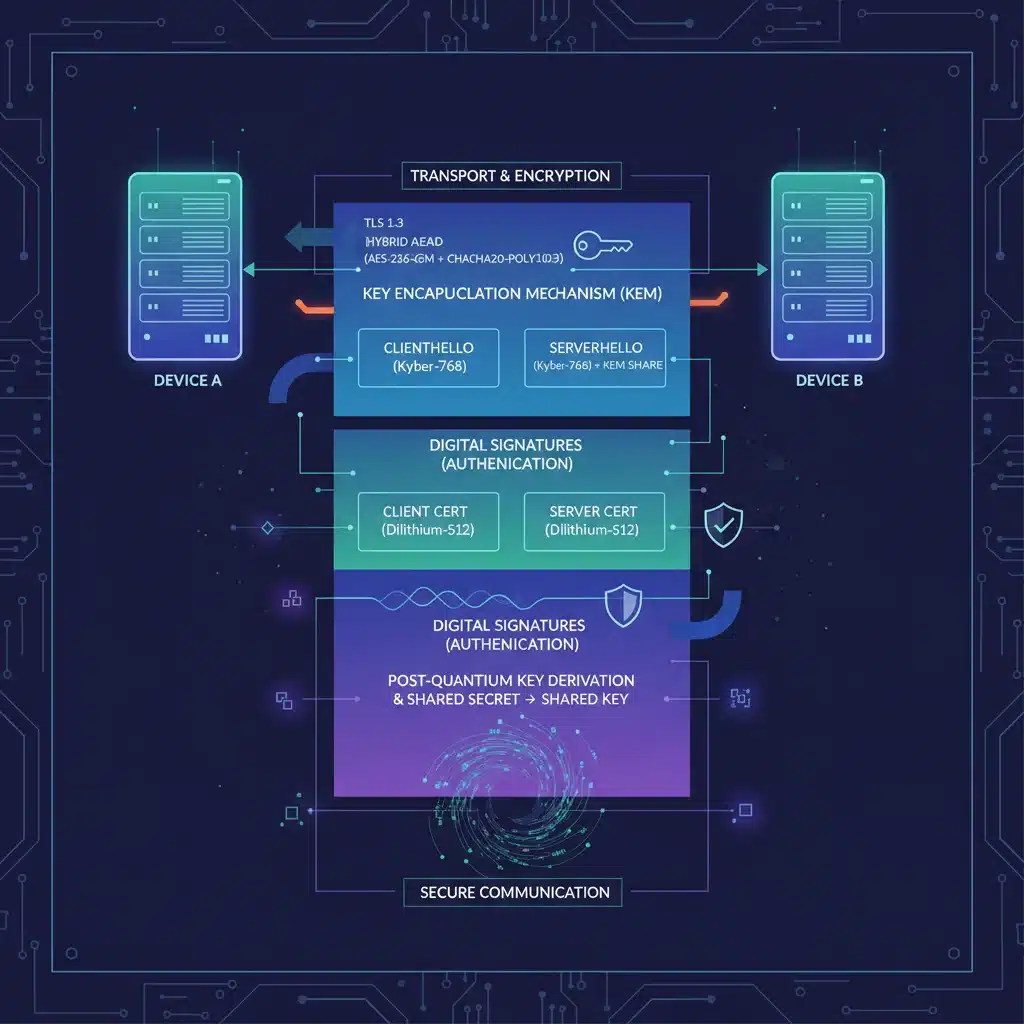
The National Institute of Standards and Technology (NIST) has been at the forefront of a global effort to standardize PQC algorithms. After years of rigorous evaluation and competition, NIST announced its first set of standardized PQC algorithms in 2022, marking a significant step towards practical implementation. These standards will form the backbone of future Quantum Cybersecurity Protocols, providing a foundation for secure communication and data storage in the quantum era.
Developing and Implementing Quantum Cybersecurity Protocols
The transition to quantum-resistant cryptography is not a simple ‘patch and update’ operation. It requires a comprehensive strategy encompassing discovery, assessment, prioritization, and migration. The sheer scale and complexity of modern IT infrastructures, coupled with the long lifespan of some encrypted data, necessitate a carefully planned and executed approach.
Key Steps in Protocol Development and Implementation:
- Inventory and Discovery: Organizations must first identify all cryptographic assets, including algorithms, protocols, hardware, and software that rely on classical cryptography. This includes identifying where sensitive data is stored and how it is protected.
- Risk Assessment: Evaluate the potential impact of a quantum attack on each identified asset. Prioritize systems based on the sensitivity of the data they protect and their exposure to long-term harvesting.
- Algorithm Selection and Testing: Based on NIST’s recommendations and specific organizational needs, select appropriate PQC algorithms. Rigorous testing is crucial to ensure their effectiveness, efficiency, and compatibility with existing systems.
- Migration Strategy: Develop a phased migration plan. This will likely involve a ‘hybrid’ approach initially, where both classical and PQC algorithms are used concurrently to provide backward compatibility and a safety net during the transition. This dual-layer protection ensures that even if one algorithm is compromised, the other can maintain security.
- Infrastructure Upgrade: Update hardware and software to support new PQC algorithms. This can range from cryptographic modules and network devices to operating systems and applications.
- Quantum-Resistant Key Management: Establish robust key management practices tailored for PQC. This includes secure generation, distribution, storage, and revocation of quantum-resistant keys.
- Continuous Monitoring and Adaptation: The quantum landscape is evolving. Organizations must continuously monitor advancements in quantum computing and cryptography, adapting their Quantum Cybersecurity Protocols as new threats and solutions emerge.
Challenges and Considerations for US Data Protection
Implementing Quantum Cybersecurity Protocols across the vast and interconnected US data ecosystem presents several unique challenges.
Technical Challenges:
- Performance Overhead: Some PQC algorithms may introduce increased computational overhead or larger key sizes compared to classical algorithms, potentially impacting network performance and storage requirements. Optimizing these algorithms for real-world deployment is an ongoing area of research.
- Interoperability: Ensuring seamless interoperability between different systems and organizations during the migration period is critical. Standardized protocols and clear guidelines are essential to avoid fragmentation.
- Cryptographic Agility: Building systems with cryptographic agility – the ability to easily swap out cryptographic algorithms – is crucial. This prepares systems for future algorithm updates or replacements as the PQC field matures.
Strategic and Policy Challenges:
- Government Mandates and Funding: Clear directives and substantial funding from the US government will be necessary to drive widespread adoption of PQC across federal agencies, critical infrastructure, and the private sector.
- Supply Chain Security: The supply chain for cryptographic hardware and software must be secured against quantum-era vulnerabilities. This means ensuring that components are manufactured and delivered without malicious quantum-resistant backdoors.
- Workforce Development: There is a significant shortage of cybersecurity professionals with expertise in quantum computing and PQC. Investing in education and training programs is vital to build a skilled workforce capable of implementing and managing these advanced systems.
- International Cooperation: Quantum threats are global. International collaboration with allies and partners is essential to share research, standardize protocols, and collectively enhance global cybersecurity posture against quantum attacks.
The Role of Government and Industry Collaboration
Protecting US data in the quantum era requires an unprecedented level of collaboration between government, industry, and academia. The NIST PQC standardization process is a prime example of successful collaboration, bringing together experts from around the world to address a common threat.
Key Areas of Collaboration:
- Research and Development: Continued investment in fundamental and applied research into quantum-resistant algorithms, quantum-safe communication networks (like quantum key distribution – QKD), and quantum-resistant hardware.
- Information Sharing: Establishing secure channels for sharing threat intelligence, best practices, and lessons learned regarding quantum cybersecurity.
- Standardization and Regulation: Working together to develop and enforce clear standards and regulatory frameworks that mandate the adoption of PQC in critical sectors.
- Pilot Programs and Testbeds: Creating environments for testing and validating Quantum Cybersecurity Protocols in real-world scenarios, allowing for early identification and resolution of implementation challenges.
- Public-Private Partnerships: Fostering partnerships that leverage the innovation of the private sector with the resources and strategic guidance of the government to accelerate PQC deployment.

Future Outlook: Beyond 2026
While 2026 is a critical target for initial quantum readiness, the journey of securing data against quantum threats is continuous. The field of quantum computing is rapidly evolving, and what is considered quantum-resistant today might need re-evaluation in the future. Therefore, a forward-looking and adaptable approach to Quantum Cybersecurity Protocols is essential.
Emerging Technologies and Concepts:
- Quantum Key Distribution (QKD): While QKD offers theoretically unbreakable encryption based on the laws of quantum mechanics, its practical deployment is currently limited by distance and infrastructure requirements. It is likely to complement PQC rather than replace it entirely, especially for highly sensitive, point-to-point communications.
- Quantum-Safe Hardware: Developing cryptographic hardware that is inherently resistant to quantum attacks, potentially integrating PQC algorithms directly into chips and devices.
- Quantum-Resistant Random Number Generators: Ensuring the randomness of cryptographic keys is paramount. Quantum random number generators (QRNGs) can provide truly random numbers, enhancing the security of PQC systems.
The US must maintain its leadership in quantum information science and cybersecurity to stay ahead of potential adversaries. This involves not only developing and deploying advanced cryptographic solutions but also investing in a robust talent pipeline, fostering a culture of cybersecurity awareness, and continuously refining its strategic approach to national data protection.
Conclusion
The dawn of the quantum era presents both immense opportunities and profound threats. For the United States, the security of its data, from classified government communications to personal financial records, hinges on its ability to effectively implement Quantum Cybersecurity Protocols. The 2026 timeline serves as a stark reminder of the urgency of this mission. By embracing Post-Quantum Cryptography, fostering strong collaborations, and maintaining a proactive stance on research and development, the US can build a resilient digital infrastructure capable of withstanding the quantum challenge. The time to act is now, to ensure that the future of US data remains secure and private in an increasingly quantum-powered world.