AI in Social Media Content: US Trends & Future 2026+
Anúncios
The Impact of AI on Social Media Content Creation: A U.S. Perspective for 2026 and Beyond
In the rapidly evolving digital landscape, artificial intelligence (AI) has emerged as a game-changer, fundamentally reshaping industries across the globe. Nowhere is this transformation more evident than in the realm of social media content creation. For businesses, marketers, and individual creators in the United States, understanding the profound impact of AI social media content is no longer optional; it’s a critical imperative for staying relevant and competitive. As we look towards 2026 and beyond, AI’s role is set to become even more pervasive, sophisticated, and indispensable, driving unprecedented levels of efficiency, personalization, and engagement.
Anúncios
The U.S. market, characterized by its vast consumer base, diverse demographics, and rapid technological adoption, serves as a crucial battleground for AI innovation in social media. From automating mundane tasks to generating hyper-personalized content at scale, AI is not just augmenting human capabilities but is also opening up entirely new avenues for creative expression and strategic marketing. This article will delve deep into the current state of AI in social media content creation, explore its multifaceted benefits and challenges, shed light on ethical considerations, and project its trajectory for the coming years, offering a comprehensive U.S. perspective.
The Current Landscape: How AI is Reshaping Social Media Content in the U.S.
The integration of AI social media content tools is already widespread, even if often unseen by the average consumer. For creators and businesses, AI is a powerful assistant that streamlines workflows and enhances output. Here are some key areas where AI is making a significant difference:
Automated Content Generation and Curation
Gone are the days when every piece of content required manual ideation and creation. AI-powered tools can now generate text, headlines, social media captions, and even short-form video scripts based on specified parameters and target audience analysis. This capability is particularly valuable for brands needing to maintain a consistent online presence across multiple platforms. Moreover, AI excels at content curation, sifting through vast amounts of data to identify trending topics, relevant articles, and influential voices, helping creators stay ahead of the curve.
Anúncios
Personalization at Scale
One of AI’s most impactful contributions is its ability to enable hyper-personalization. By analyzing user behavior, preferences, and demographics, AI algorithms can tailor content recommendations, ad placements, and even the tone of messaging to individual users. In the U.S., where consumers expect highly relevant experiences, this level of personalization is crucial for cutting through the noise and fostering deeper engagement. Imagine a retail brand using AI to recommend specific outfits to users based on their browsing history, local weather, and previous purchases – this is the power of AI social media content in action.
Advanced Analytics and Performance Prediction
Understanding what resonates with an audience is paramount. AI-driven analytics tools go beyond basic metrics, offering predictive insights into content performance. They can forecast which types of posts will generate the most engagement, identify optimal posting times, and even suggest improvements to content before it’s published. This data-driven approach allows U.S. marketers to refine their strategies continuously, maximizing ROI and minimizing wasted effort.
Visual Content Enhancement and Generation
From image recognition to video editing, AI is revolutionizing visual content. AI tools can enhance image quality, remove backgrounds, suggest optimal cropping, and even generate entirely new images and videos from text prompts. This empowers creators to produce high-quality visual assets quickly and efficiently, democratizing access to professional-grade design tools. The rise of AI-generated art and deepfakes (though with ethical implications we’ll discuss later) showcases the advanced capabilities in this domain.
Sentiment Analysis and Community Management
Monitoring brand reputation and engaging with communities can be time-consuming. AI-powered sentiment analysis tools can track mentions across social media, gauge public opinion, and flag urgent issues, allowing brands to respond proactively. Chatbots and AI assistants are also increasingly used to handle routine customer inquiries and provide instant support, freeing up human moderators for more complex interactions.
Benefits and Opportunities for U.S. Businesses and Creators
The adoption of AI social media content strategies offers a plethora of advantages for those operating in the U.S. market:
- Increased Efficiency and Productivity: AI automates repetitive tasks, allowing human teams to focus on strategy, creativity, and high-value interactions. This translates to faster content cycles and more output with fewer resources.
- Enhanced Personalization and Engagement: Tailored content leads to higher relevance, increased click-through rates, and stronger audience connections, fostering loyalty and driving conversions.
- Improved Content Quality and Consistency: AI tools can ensure brand voice consistency, grammar accuracy, and adherence to style guides, elevating the overall quality of published content.
- Data-Driven Decision Making: Predictive analytics provide actionable insights, enabling marketers to make informed decisions and optimize their strategies for maximum impact.
- Cost Reduction: By automating tasks and optimizing performance, AI can significantly reduce operational costs associated with content creation and marketing campaigns.
- Expanded Creative Possibilities: AI acts as a creative partner, suggesting new ideas, formats, and angles that might not have been considered otherwise, pushing the boundaries of what’s possible in content.
Challenges and Ethical Considerations in the U.S. Context
While the benefits are clear, the rapid advancement of AI social media content also presents significant challenges and ethical dilemmas that the U.S. market is grappling with:
Bias and Fairness
AI models are trained on vast datasets, and if these datasets contain inherent biases (e.g., racial, gender, cultural), the AI will perpetuate and amplify them. This can lead to discriminatory content, unfair targeting, or misrepresentation, which is a significant concern in the diverse U.S. landscape. Ensuring fairness and mitigating bias in AI algorithms is a crucial ongoing effort.
Authenticity and Trust
As AI becomes more sophisticated in generating realistic text, images, and videos, the line between human-created and AI-generated content blurs. This raises questions about authenticity and trust. Can consumers trust the content they see online? The rise of deepfakes and AI-generated misinformation poses a serious threat to public discourse and brand reputation, necessitating clear disclosure guidelines and robust detection methods.
Job Displacement and Skill Gaps
The automation capabilities of AI raise concerns about job displacement in content creation roles. While AI is likely to augment rather than fully replace human creativity, there will be a shift in required skills. U.S. professionals will need to adapt, focusing on AI oversight, strategic thinking, and creative direction rather than purely generative tasks.
Data Privacy and Security
AI models require immense amounts of data to learn and operate effectively. This intensifies concerns around data privacy, especially with stringent regulations like GDPR (and similar state-level initiatives in the U.S.). Ensuring the secure and ethical collection, storage, and use of user data is paramount to maintaining consumer trust and avoiding legal repercussions.
Copyright and Ownership
Who owns the copyright to content generated by an AI? If an AI creates an image or text based on existing copyrighted material, what are the legal implications? These are complex questions that U.S. legal frameworks are still catching up to, creating uncertainty for creators and businesses leveraging AI social media content tools.
The Future of AI Social Media Content in the U.S. (2026 and Beyond)
Looking ahead, the evolution of AI social media content promises an even more integrated and transformative experience. Here’s what we can expect beyond 2026:
Hyper-Realistic and Immersive Experiences
As AI converges with advancements in virtual reality (VR) and augmented reality (AR), we can anticipate the creation of hyper-realistic and interactive social media content. Imagine AI-generated virtual influencers hosting live events in the metaverse, or AI crafting personalized AR filters that dynamically adapt to user environments. This will unlock new dimensions of engagement and brand storytelling.
Proactive Content Generation and Predictive Engagement
AI won’t just react to trends; it will proactively anticipate them. Advanced AI models will be able to predict emerging cultural shifts, consumer needs, and viral content formats, generating relevant content even before the demand fully materializes. This predictive capability will give early adopters a significant competitive edge in the U.S. market.
AI as a Creative Partner and Muse
The role of AI will shift from being merely a tool to a true creative partner. Artists, writers, and designers will collaborate with AI systems to push creative boundaries, using AI to brainstorm ideas, generate variations, and refine artistic outputs. This human-AI co-creation will lead to unprecedented levels of innovation and unique content experiences.
Ethical AI and Transparent Practices
As AI becomes more ubiquitous, there will be an increased emphasis on ethical AI development and transparent practices. U.S. consumers and regulators will demand clear disclosure of AI-generated content, robust bias detection, and explainable AI models. Companies that prioritize ethical AI will build greater trust and credibility.
Voice and Multimodal Content Dominance
The rise of voice search and smart assistants will drive the demand for AI-generated voice content. Beyond 2026, we can expect AI to seamlessly create and optimize content across various modalities – text, image, video, and audio – adapting it for different platforms and consumption preferences. This multimodal approach will be key to reaching diverse audiences effectively.
Autonomous Content Marketing Systems
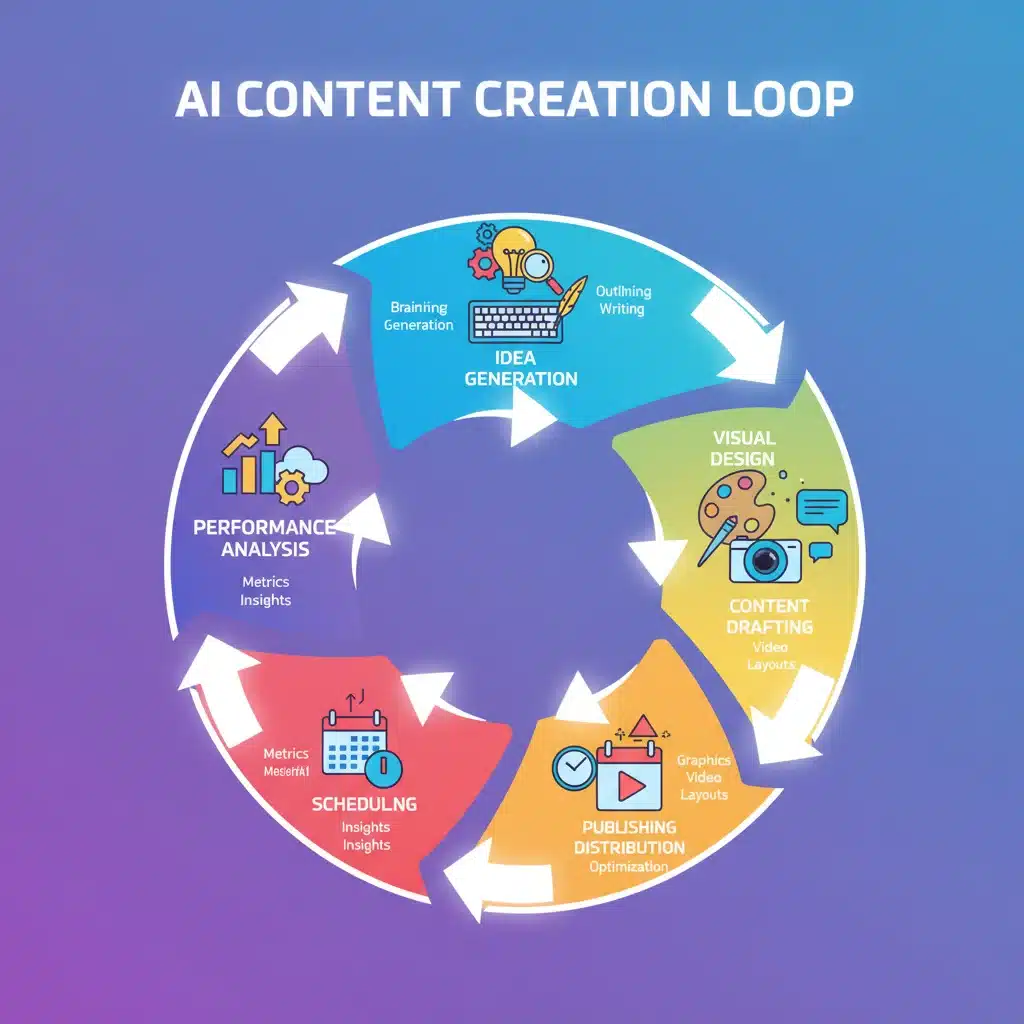
The ultimate vision for AI social media content involves autonomous systems that can manage entire content marketing campaigns from ideation to execution and analysis. These systems will continuously learn, adapt, and optimize, requiring minimal human intervention while delivering maximum results. This could revolutionize how brands manage their digital presence.
Strategies for U.S. Businesses and Creators to Thrive
To navigate this future, U.S. businesses and content creators must adopt forward-thinking strategies:
- Invest in AI Tools and Training: Embrace AI as an essential part of your content toolkit. Provide training for your teams to develop the skills needed to effectively leverage AI technologies.
- Focus on Human-AI Collaboration: Understand that AI is a co-pilot, not a replacement. Emphasize human creativity, strategic oversight, and ethical judgment in partnership with AI’s efficiency.
- Prioritize Ethical AI Use: Develop clear guidelines for AI content creation, including disclosure, bias mitigation, and responsible data handling. Build consumer trust through transparency.
- Stay Agile and Adaptable: The AI landscape is constantly changing. Be prepared to experiment with new tools, adapt strategies, and continuously learn to stay ahead.
- Emphasize Authenticity and Brand Voice: While AI can generate content, maintaining a unique and authentic brand voice will be crucial for differentiation. AI should enhance, not dilute, your brand identity.
- Champion Creativity and Critical Thinking: As AI handles more routine tasks, human creativity, critical thinking, and emotional intelligence will become even more valuable assets.

Case Studies: AI in Action in the U.S.
Several U.S. companies are already demonstrating the power of AI social media content:
Netflix: Personalizing Content Recommendations
While not strictly social media content, Netflix’s use of AI to personalize content recommendations is a prime example of how AI understands user preferences to deliver highly relevant suggestions. This same principle is now being applied to social media feeds, ensuring users see content they are most likely to engage with.
The Washington Post: Automated Journalism
The Washington Post has utilized its AI tool, Heliograf, to generate short news updates and reports, especially for events like election results and sports scores. This frees up human journalists to focus on in-depth investigative reporting and analysis, showcasing AI’s role in augmenting newsroom productivity.
Chipotle: AI-Powered TikTok Campaigns
Chipotle has successfully leveraged AI and data analytics to identify trending sounds and challenges on TikTok, creating viral campaigns that resonate deeply with Gen Z. Their ability to quickly jump on trends and generate engaging content demonstrates a sophisticated understanding of AI-driven social media dynamics.
Grammarly: Enhancing Written Content
Grammarly, a widely used AI-powered writing assistant, helps millions of U.S. users improve their writing across various platforms, including social media. It offers not just grammar and spelling corrections but also suggestions for tone, clarity, and conciseness, directly impacting the quality of text-based social media posts.
The Regulatory Landscape and Future Governance
The rapid advancement of AI in content creation also brings into focus the need for appropriate regulatory frameworks. In the U.S., discussions are ongoing regarding:
- AI Ethics Guidelines: The National Institute of Standards and Technology (NIST) has published an AI Risk Management Framework, providing voluntary guidance for developing and deploying trustworthy AI.
- Content Labeling: There’s a growing call for mandatory labeling of AI-generated content, particularly for deepfakes and synthetic media, to combat misinformation and maintain transparency.
- Copyright Reform: The U.S. Copyright Office is actively reviewing how existing copyright laws apply to AI-generated works, a critical area for content creators and platforms.
- Data Privacy Legislation: States like California (CCPA/CPRA) have led the way in data privacy, and federal legislation is anticipated to provide a comprehensive framework for how AI systems handle personal data.
These regulatory developments will significantly shape how AI social media content is created, distributed, and consumed in the coming years, aiming to balance innovation with protection.
Conclusion: Navigating the AI-Powered Social Media Future
The impact of AI on social media content creation in the U.S. is undeniable and irreversible. As we move towards 2026 and beyond, AI will continue to evolve, offering unparalleled opportunities for efficiency, personalization, and creative expression. However, this transformative power comes with responsibilities. Addressing ethical concerns, ensuring transparency, and fostering human-AI collaboration will be paramount for unlocking AI’s full potential while mitigating its risks.
For businesses and creators in the United States, the future of social media success lies in embracing AI not as a threat, but as a powerful ally. By understanding its capabilities, navigating its complexities, and committing to ethical deployment, we can collectively shape a future where AI social media content enriches our digital experiences, fosters genuine connections, and drives meaningful engagement in an ever-evolving online world.
The journey has just begun, and the landscape of social media is poised for its most exciting, AI-driven transformation yet.