Digital Nomad Financial Benefits: US Tech Workers 2026 Outlook

Anúncios
The Rise of Digital Nomads: 3 Economic Benefits for US Tech Workers by 2026 (Financial Impact)
The landscape of work has fundamentally shifted, and at the forefront of this transformation is the burgeoning phenomenon of digital nomadism. For US tech workers, in particular, this isn’t just a lifestyle choice; it’s a strategic financial maneuver. By 2026, the economic benefits for those embracing the digital nomad lifestyle are poised to be substantial, offering a compelling alternative to traditional office-bound careers. This comprehensive article delves into the three primary financial advantages that make becoming a digital nomad an increasingly attractive and lucrative option for US tech professionals.
The allure of working remotely from exotic locales, experiencing new cultures, and gaining unparalleled flexibility is undeniable. However, beneath the surface of wanderlust lies a robust framework of financial incentives that are driving this movement. As technology continues to enable seamless global connectivity and companies increasingly adopt remote-first policies, the opportunities for US tech workers to optimize their personal finances through digital nomadism are expanding exponentially. We will explore how strategic planning around tax implications, significant reductions in the cost of living, and the potential for increased earning power are reshaping the financial futures of these pioneering professionals.
Anúncios
Understanding the Digital Nomad Phenomenon for US Tech Workers
Before we dissect the financial benefits, it’s crucial to grasp what digital nomadism entails for US tech workers. It’s not merely about working remotely; it’s about leveraging that remote capability to live and work from anywhere in the world, often moving between locations. This lifestyle is particularly well-suited for tech professionals – software engineers, data scientists, UX/UI designers, cybersecurity experts, and IT consultants – whose skills are in high demand and whose work is predominantly location-independent. The tools of their trade are often just a laptop and a reliable internet connection, making them ideal candidates for this global shift.
The pandemic acted as a catalyst, accelerating the acceptance and adoption of remote work models. What was once a niche concept is now a mainstream aspiration for many. Companies have invested heavily in remote infrastructure, and employees have proven their productivity outside traditional office settings. This cultural and technological shift has paved the way for more US tech workers to consider and successfully implement a digital nomad lifestyle. The financial implications, as we will see, are profound and multifaceted, impacting everything from daily expenses to long-term wealth accumulation.
Anúncios
The global landscape is also evolving to accommodate this new demographic. Countries are introducing special digital nomad visas, offering legal pathways for remote workers to reside and contribute to their economies. This formal recognition further legitimizes the lifestyle and provides a stable environment for US tech workers to operate in, reducing uncertainties related to immigration and residency. This growing support infrastructure, combined with the inherent flexibility of tech roles, makes the financial advantages of digital nomadism more accessible and sustainable than ever before. The keyword, digital nomad finances, becomes central to understanding this new economic paradigm.
Benefit 1: Significant Cost of Living Reduction
One of the most immediate and impactful financial advantages for US tech workers becoming digital nomads is the drastic reduction in the cost of living. The United States, particularly its major tech hubs like Silicon Valley, New York, and Seattle, is renowned for its high cost of living. Housing, in particular, consumes a significant portion of a tech worker’s income. By relocating to countries with lower living expenses, digital nomads can stretch their US-based salaries considerably further.
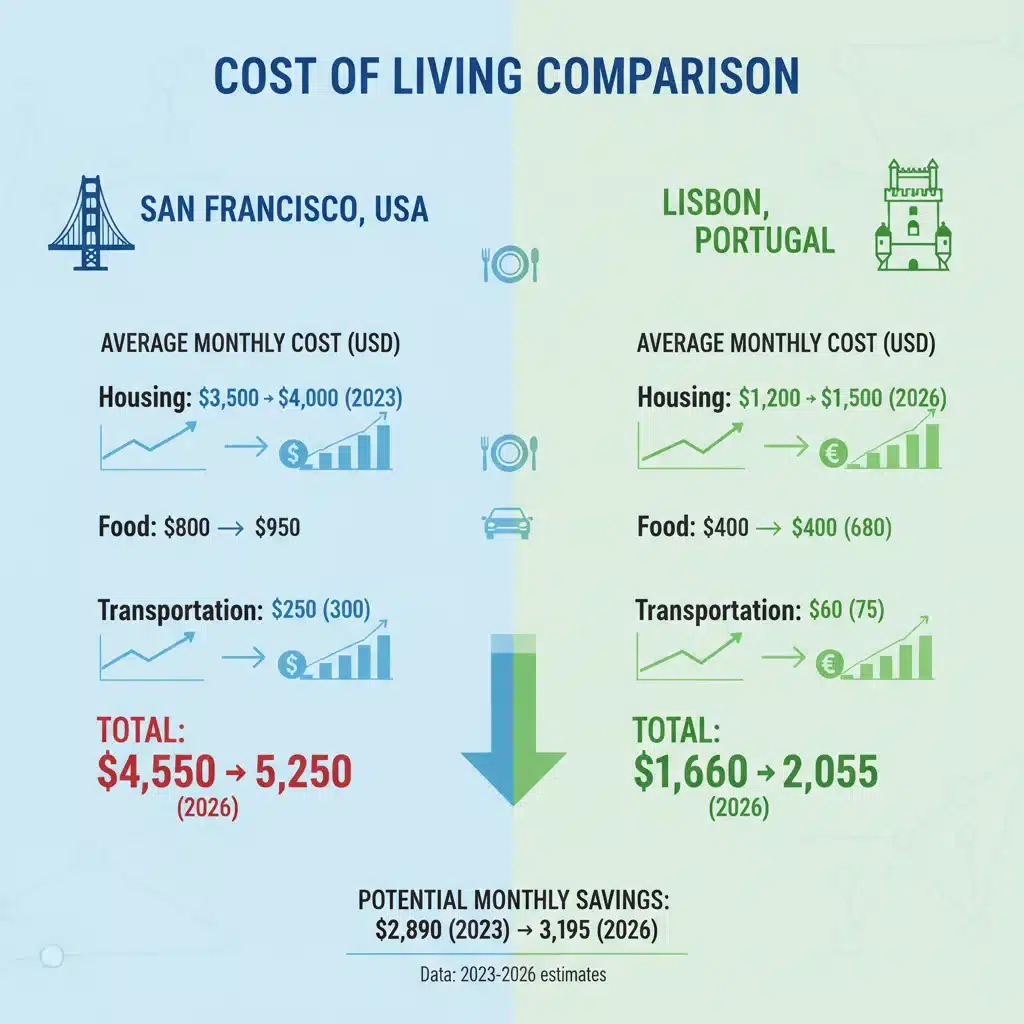
Consider the stark contrast: a one-bedroom apartment in San Francisco can easily cost upwards of $3,000-$4,000 per month. In popular digital nomad destinations such as Lisbon, Portugal; Medellín, Colombia; or Chiang Mai, Thailand, a comparable or even higher quality of life can be achieved for a fraction of that cost. Monthly rent for a comfortable apartment in these cities might range from $500 to $1,500, freeing up thousands of dollars each month. This isn’t just about cheaper rent; it extends to almost every aspect of daily life.
Food, transportation, entertainment, and even healthcare can be significantly more affordable outside the US. Eating out, for instance, can be a daily luxury in many countries, whereas it’s often a budget strain in American cities. Public transport systems are often more developed and cost-effective, reducing the need for expensive car ownership, insurance, and fuel. These savings compound over time, leading to substantial improvements in a digital nomad’s disposable income and savings rate. This directly impacts their digital nomad finances.
Real-World Examples of Cost Savings by 2026
Let’s project some figures for a US tech worker earning, for example, $120,000 annually. In a high-cost US city, after taxes, rent, utilities, and other essential expenses, their discretionary income might be limited. If they move to a country where the cost of living is 50-70% lower, their effective purchasing power skyrockets. This isn’t just theoretical; it’s a proven reality for countless digital nomads.
- Housing: Saving $2,000-$3,000 per month on rent alone translates to $24,000-$36,000 annually.
- Food: A conservative estimate of saving $500-$1,000 per month on groceries and dining out adds another $6,000-$12,000 per year.
- Transportation: Eliminating car payments, insurance, and gas could save $500-$800 per month, or $6,000-$9,600 annually.
- Healthcare: While complex, many countries offer affordable private healthcare options that can be less expensive than US premiums, especially for younger, healthy individuals.
These combined savings can easily amount to $40,000-$60,000 or more per year. This significant increase in disposable income can be allocated towards investments, paying off debt, travel, or simply building a larger emergency fund. For US tech workers, this financial leverage is a powerful motivator to embrace the digital nomad lifestyle, fundamentally altering their long-term financial trajectory and enhancing their digital nomad finances significantly.
Benefit 2: Optimized Tax Strategies and Potential Tax Reductions
The second major financial benefit for US tech workers as digital nomads revolves around optimized tax strategies and the potential for significant tax reductions. While navigating international tax laws can be complex, understanding and leveraging specific provisions can lead to substantial savings. The primary tool for many US citizens working abroad is the Foreign Earned Income Exclusion (FEIE).
The FEIE allows qualified US citizens or resident aliens who live and work abroad to exclude a certain amount of their foreign earned income from US federal income tax. For the tax year 2023, this exclusion was $120,000, and it is adjusted annually for inflation. This means that a US tech worker earning up to this amount while living and working outside the United States for the majority of the year could potentially pay zero US federal income tax on that income. This is a game-changer for digital nomad finances.
Understanding the Foreign Earned Income Exclusion (FEIE)
To qualify for the FEIE, a US citizen must meet one of two tests:
- The Bona Fide Residence Test: This requires you to be a bona fide resident of a foreign country (or countries) for an uninterrupted period that includes an entire tax year. This generally means establishing a true home in a foreign country.
- The Physical Presence Test: This requires you to be physically present in a foreign country (or countries) for at least 330 full days during any period of 12 consecutive months. This is often the more straightforward path for many digital nomads who move frequently.
It’s crucial to note that while the FEIE can reduce US federal income tax, digital nomads might still be subject to taxes in the foreign countries where they reside and work. However, many countries have lower income tax rates than the US, or they offer special tax incentives for digital nomads. Furthermore, the Foreign Tax Credit (FTC) can often be used to offset any foreign taxes paid against any remaining US tax liability, preventing double taxation.
Strategic planning is key. Consulting with an international tax specialist is highly recommended to ensure compliance and maximize benefits. They can help navigate the nuances of tax treaties, residency rules, and the specific tax laws of chosen countries. By effectively utilizing the FEIE and other international tax provisions, US tech workers can significantly boost their net income, making their digital nomad finances much more robust.
Benefit 3: Increased Earning Potential and Career Growth
While often overlooked, the digital nomad lifestyle can also lead to increased earning potential and accelerated career growth for US tech workers. This might seem counterintuitive at first, especially if one considers the initial premise of cost savings. However, several factors contribute to this.
Firstly, the global exposure gained from living and working in diverse environments can significantly enhance a tech worker’s skill set and perspective. Exposure to different markets, business practices, and cultural contexts can make them more adaptable, innovative, and valuable to employers. This broadens their understanding of global user bases and technological needs, which is highly prized in today’s interconnected tech industry. This enhanced global perspective directly contributes to their career trajectory and ultimately their digital nomad finances.

Leveraging Global Opportunities and Skill Development
Secondly, the flexibility of the digital nomad lifestyle allows tech workers to pursue a wider range of job opportunities. They are not limited by geographical constraints, meaning they can apply for the best-paying remote positions regardless of where the company is based. This expands their job market significantly beyond just US-based roles, potentially accessing higher-paying international contracts or projects that value their unique perspective and flexibility.
- Access to Global Talent Pools: Digital nomads can tap into a global network of professionals, leading to collaborations and learning opportunities that might not be available within a single geographic location.
- Entrepreneurial Ventures: The reduced cost of living and increased free time can empower tech workers to pursue side hustles, build their own startups, or engage in freelance projects. With lower overheads, the risk associated with entrepreneurial ventures is reduced, making it easier to experiment and grow their income streams. Many successful tech startups have been founded by individuals living a digital nomad lifestyle, leveraging global talent and lower operating costs.
- Skill Diversification: Living abroad often requires learning new languages, navigating unfamiliar systems, and adapting to change. These soft skills, combined with their technical expertise, make digital nomads incredibly well-rounded and attractive candidates for leadership roles or specialized projects that demand a global mindset.
By 2026, as remote work becomes even more entrenched and global talent markets become more fluid, US tech workers who embrace digital nomadism will be uniquely positioned to capitalize on these trends. Their ability to live affordably, optimize taxes, and continuously develop their skills in a global context will translate into substantial long-term financial growth and career advancement, significantly boosting their digital nomad finances.
Challenges and Considerations for Digital Nomad Finances
While the financial benefits are compelling, it’s important to acknowledge potential challenges and considerations. The digital nomad lifestyle isn’t without its complexities, especially when it comes to managing finances across borders. Understanding these can help US tech workers prepare effectively and mitigate risks.
Navigating International Banking and Currency Exchange
Managing multiple bank accounts, dealing with currency exchange rates, and ensuring seamless international transfers are practical aspects that digital nomads must master. Fluctuations in exchange rates can impact the real value of their earnings and savings. Utilizing wise financial tools and services designed for international living, such as multi-currency accounts or low-fee transfer services, becomes essential. Planning for these aspects is crucial for maintaining stable digital nomad finances.
Healthcare and Insurance Abroad
Healthcare is a significant concern for any US citizen, and it remains so for digital nomads. While some countries offer affordable healthcare, securing comprehensive international health insurance is paramount. This can be an additional expense, but it’s a non-negotiable one for peace of mind and financial security in case of illness or accident. Researching and investing in a robust international health insurance plan tailored for digital nomads is a critical step.
Residency, Visas, and Legal Compliance
The legal framework for digital nomads is still evolving. While many countries are introducing digital nomad visas, staying compliant with immigration laws, visa requirements, and local regulations is crucial. Overstaying visas or working illegally can lead to severe penalties, impacting financial stability and future travel opportunities. Thorough research into the visa options and residency requirements of chosen destinations is essential for long-term sustainable digital nomad finances.
Tax Complexity and Professional Advice
As mentioned, international tax laws are intricate. While the FEIE offers significant benefits, misinterpreting rules or failing to file correctly can lead to penalties. It is highly advisable to consult with tax professionals specializing in expat taxes to ensure full compliance with both US and foreign tax obligations. This investment in expert advice can prevent costly mistakes and optimize tax savings, safeguarding digital nomad finances.
Building a Strong Financial Safety Net
Given the inherent uncertainties of international travel and remote work, building a substantial emergency fund is even more critical for digital nomads. Unexpected travel costs, medical emergencies, or temporary periods of unemployment require a robust financial safety net. Experts often recommend having at least 6-12 months of living expenses saved, which provides security and flexibility.
The Future of Digital Nomadism and US Tech Workers by 2026
Looking ahead to 2026, the trend of US tech workers embracing digital nomadism is only expected to accelerate. The confluence of technological advancements, evolving corporate policies, and a global shift in work culture creates an increasingly fertile ground for this lifestyle. The financial benefits discussed – reduced cost of living, optimized tax strategies, and increased earning potential – will become even more pronounced and accessible.
Governments worldwide are recognizing the economic contributions of digital nomads and are actively creating more welcoming environments. This includes not just digital nomad visas but also improved infrastructure, co-working spaces, and communities tailored to remote professionals. This supportive ecosystem will further reduce the barriers to entry and enhance the overall experience, making it easier for US tech workers to thrive financially as nomads.
Furthermore, the demand for tech skills remains incredibly high globally. US tech workers, with their often superior training and experience, are well-positioned to command competitive salaries even when working remotely for international clients or companies. This global demand, combined with the ability to live in lower-cost regions, creates a powerful economic arbitrage opportunity that few other professions can match.
The long-term financial implications for those who successfully navigate the digital nomad lifestyle are significant. Imagine saving an additional $50,000 per year for five years. That’s a quarter-million dollars that can be invested, used for a down payment on property (perhaps even in a lower-cost country), or contribute significantly to early retirement goals. The compounding effect of these savings and investments can lead to unprecedented financial independence for US tech workers by 2026 and beyond.
Conclusion: A Path to Financial Freedom for US Tech Workers
The digital nomad lifestyle presents a transformative opportunity for US tech workers to redefine their careers and achieve unprecedented financial freedom. By strategically leveraging the significant reduction in the cost of living in many international destinations, optimizing their tax obligations through provisions like the Foreign Earned Income Exclusion, and actively pursuing global opportunities that enhance their earning potential and career growth, these professionals are charting a new course for their digital nomad finances.
By 2026, the economic advantages will be more apparent than ever, solidified by a growing global infrastructure supporting remote work and an increasing acceptance of location-independent careers. While challenges exist in navigating international regulations, banking, and healthcare, these are surmountable with careful planning, research, and professional guidance.
For the ambitious US tech worker, digital nomadism is more than just an adventure; it’s a calculated and highly rewarding financial strategy. It offers a pathway to accelerate savings, pay off debt faster, invest more aggressively, and ultimately achieve a level of financial independence that might be elusive in high-cost domestic environments. The future is remote, global, and for many US tech workers, financially liberating. Embracing the digital nomad lifestyle is not just about seeing the world; it’s about building a wealthier, more fulfilling life, one international destination at a time.