Quantum Computing US: Early Adopter Strategies for 2026 and Beyond

The technological landscape is on the cusp of a profound transformation, one that promises to redefine industries, unlock unprecedented computational power, and solve problems previously deemed intractable. At the heart of this revolution lies Quantum Computing US, a field where the United States is rapidly establishing itself as a global leader. As we look towards 2026 and beyond, the question for businesses and innovators isn’t if quantum computing will arrive, but how they can effectively prepare for and harness its immense potential.
This comprehensive guide will explore the rise of Quantum Computing US, delving into the core principles, the current state of play, and, most importantly, the strategic considerations for early adopters. We’ll examine the benefits, navigate the challenges, and outline actionable strategies for organizations eager to integrate quantum capabilities into their future operations. The quantum era is not a distant dream; it’s a rapidly approaching reality, and those who start planning now will be best positioned to thrive.
Understanding the Quantum Leap: What is Quantum Computing?
Before diving into strategies for Quantum Computing US, it’s essential to grasp the fundamental concepts that differentiate it from classical computing. While classical computers rely on bits that represent information as either 0 or 1, quantum computers utilize qubits. Qubits possess two extraordinary properties: superposition and entanglement.
Superposition: Beyond Binary States
Superposition allows a qubit to exist in multiple states simultaneously – a combination of 0 and 1 – until it is measured. This intrinsic ability to hold complex information exponentially increases the computational power compared to classical bits. Imagine flipping a coin: a classical bit is either heads or tails. A quantum qubit, however, can be both heads and tails (and everything in between) until it lands. This parallel processing capability is a game-changer for certain types of complex calculations.
Entanglement: The Quantum Connection
Entanglement is an even more mind-boggling phenomenon where two or more qubits become intrinsically linked, regardless of the distance separating them. The state of one entangled qubit instantaneously influences the state of the others. This ‘spooky action at a distance,’ as Einstein famously called it, allows quantum computers to perform highly correlated operations, leading to solutions that are impossible for classical machines.
Quantum Algorithms: Unlocking New Possibilities
The true power of Quantum Computing US lies in specialized quantum algorithms designed to leverage superposition and entanglement. Algorithms like Shor’s algorithm (for factoring large numbers) and Grover’s algorithm (for searching unstructured databases) demonstrate exponential speedups over their classical counterparts for specific problems. While general-purpose quantum computers are still in their nascent stages, these algorithms hint at the revolutionary potential across various sectors.
The Current Landscape of Quantum Computing in the US
The United States has emerged as a powerhouse in quantum computing research, development, and commercialization. Significant investments from government agencies, private companies, and academic institutions are fueling rapid advancements. This section will explore the key players and initiatives defining the Quantum Computing US landscape.
Government Initiatives and Funding
The US government has recognized the strategic importance of quantum technology, designating it a national priority. The National Quantum Initiative Act, signed into law in 2018, allocated over a billion dollars towards quantum research and development across various agencies, including the National Science Foundation (NSF), the Department of Energy (DOE), and the National Institute of Standards and Technology (NIST). This sustained funding is crucial for fostering innovation and maintaining a competitive edge in Quantum Computing US.
Leading Academic Institutions
Universities across the US are at the forefront of fundamental quantum research, developing new architectures, algorithms, and training the next generation of quantum scientists. Institutions like MIT, Stanford, the University of Chicago, and the University of Maryland have established dedicated quantum research centers, attracting top talent and producing groundbreaking discoveries. These academic hubs are vital incubators for the future of Quantum Computing US.
Private Sector Investment and Innovation
Tech giants and startups alike are pouring resources into quantum computing. IBM, Google, Microsoft, Honeywell, and IonQ are just a few of the prominent companies in the Quantum Computing US ecosystem. They are developing quantum hardware (superconducting qubits, trapped ions, photonic systems), software platforms, and specialized applications. This private sector engagement is accelerating the transition from theoretical research to practical, deployable quantum solutions.
Early Adopter Strategies for 2026 and Beyond
For businesses looking to gain a competitive advantage, becoming an early adopter of Quantum Computing US is a strategic imperative. However, navigating this emerging field requires a well-thought-out approach. Here are key strategies for organizations aiming to leverage quantum technology effectively from 2026 onwards.
1. Educate and Build Internal Expertise
The first step for any organization considering quantum adoption is to educate its leadership and technical teams. This involves understanding the basics of quantum mechanics, identifying potential use cases relevant to the business, and recognizing the limitations of current quantum systems. Start by:
- Establishing a Quantum Task Force: Assemble a cross-functional team with representatives from R&D, IT, strategy, and business units.
- Investing in Training: Provide access to online courses, workshops, and certifications in quantum computing for key personnel.
- Hiring Quantum Talent: As the field matures, consider bringing in quantum physicists, engineers, and algorithm developers to build in-house expertise.
2. Identify and Prioritize Quantum-Relevant Use Cases
Not all problems are suitable for quantum computing. The key is to identify specific challenges where quantum algorithms offer a significant advantage over classical methods. Focus on areas where current classical computing struggles due to computational complexity. Potential early adopter use cases for Quantum Computing US include:
- Drug Discovery and Materials Science: Simulating molecular interactions with unprecedented accuracy to discover new drugs or design novel materials.
- Financial Modeling: Optimizing portfolios, risk analysis, and fraud detection with complex, high-dimensional data.
- Logistics and Optimization: Solving complex routing problems for supply chains, transportation, and resource allocation.
- Artificial Intelligence and Machine Learning: Enhancing AI capabilities through quantum machine learning algorithms for pattern recognition and data analysis.
- Cryptography: Developing quantum-resistant encryption methods to secure data in a post-quantum world.
3. Engage with Quantum Ecosystems and Partnerships
No single organization can master the entire quantum stack. Collaborating with experts in the Quantum Computing US ecosystem is crucial. Consider:
- Partnering with Quantum Providers: Work with companies like IBM, Google, or AWS to access their quantum hardware and cloud services. This allows experimentation without significant upfront investment in physical infrastructure.
- Collaborating with Academia: Engage with university research labs on joint projects or sponsor PhD students working on relevant quantum applications.
- Joining Industry Consortia: Participate in groups focused on quantum standards, best practices, and shared research to stay abreast of developments and influence the direction of the field.
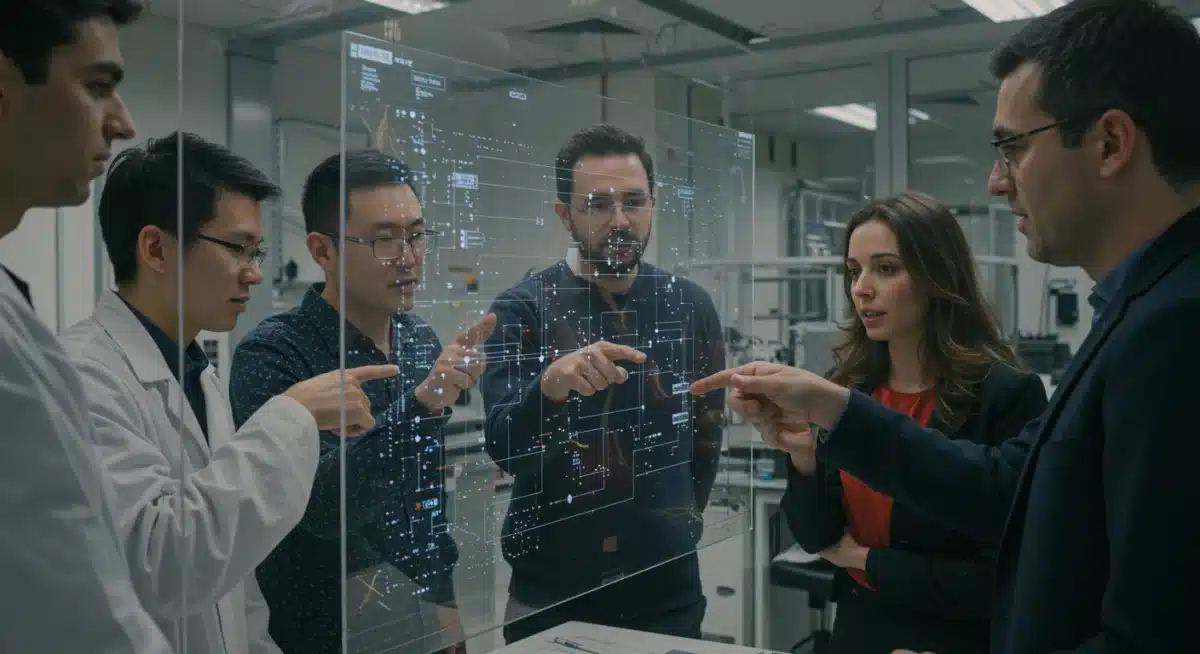
4. Start Small with Hybrid Approaches
Full-scale quantum computers are still some years away. For 2026 and beyond, the most practical approach for Quantum Computing US early adopters will involve hybrid classical-quantum computing. This means using classical computers for tasks they excel at and offloading specific, computationally intensive sub-problems to quantum processors. Begin by:
- Developing Proofs of Concept (POCs): Experiment with small-scale quantum algorithms on existing quantum simulators or early-stage hardware to validate hypotheses and gain practical experience.
- Focusing on Quantum-Inspired Algorithms: Explore algorithms that run on classical computers but leverage quantum principles to achieve better performance for optimization problems.
- Iterative Development: Adopt an agile approach, continuously refining quantum solutions as hardware and software mature.
5. Address Security and Ethical Implications
As Quantum Computing US advances, so do concerns around data security and ethical use. Organizations must proactively address these issues:
- Post-Quantum Cryptography (PQC): Begin researching and planning the transition to PQC standards to protect sensitive data from future quantum attacks. NIST is actively working on standardizing PQC algorithms.
- Ethical Frameworks: Develop internal guidelines and ethical frameworks for the responsible development and deployment of quantum technologies, considering potential societal impacts.
The Future of Quantum Computing in the US: 2026 and Beyond
Looking towards 2026 and the subsequent decade, the trajectory of Quantum Computing US is poised for accelerated growth and significant breakthroughs. Several key trends and developments are expected to shape this future.
Advancements in Qubit Coherence and Error Correction
A primary focus of research is improving qubit stability and implementing robust error correction mechanisms. As coherence times lengthen and error rates decrease, quantum computers will become more reliable and capable of tackling larger, more complex problems. This will be a critical enabler for scaling quantum systems.
Maturity of Quantum Software and Development Tools
The quantum software stack is rapidly evolving. We can expect more user-friendly programming languages, advanced compilers, and specialized software development kits (SDKs) that abstract away some of the low-level quantum mechanics. This will make quantum programming more accessible to a broader range of developers, accelerating application development within the Quantum Computing US landscape.
Increased Commercialization and Industry-Specific Solutions
As hardware matures and software tools become more robust, we will see a surge in commercial quantum applications. Instead of general-purpose machines, there will be a greater emphasis on developing quantum solutions tailored to specific industry needs, whether in finance, healthcare, manufacturing, or logistics. Companies will move beyond theoretical proofs of concept to demonstrable, value-generating applications.
The Quantum Internet and Secure Communication
Beyond computation, Quantum Computing US research is also driving the development of quantum networks. A quantum internet, leveraging entanglement for secure communication, promises unhackable data transmission. While still in early stages, by 2026 and beyond, we may see initial implementations of quantum key distribution (QKD) networks, providing ultra-secure communication channels for critical infrastructure and sensitive data.
Ethical and Regulatory Frameworks
As quantum technology becomes more powerful and pervasive, there will be an increasing need for ethical guidelines and regulatory frameworks. Discussions around the responsible development and deployment of quantum AI, the implications for national security, and the equitable access to quantum resources will intensify. The US government and international bodies will play a crucial role in shaping these frameworks to ensure quantum technology benefits all of humanity.
Impact on Education and Workforce Development
The demand for quantum-literate professionals will skyrocket. Educational institutions in the Quantum Computing US sphere will expand programs in quantum information science, making it a critical area of study from undergraduate to postgraduate levels. Continuous workforce retraining initiatives will also become vital to equip the existing talent pool with the necessary quantum skills.
Conclusion: Seizing the Quantum Opportunity in the US
The advent of Quantum Computing US represents a paradigm shift with the potential to reshape industries and economies. For businesses, government agencies, and research institutions alike, the period leading up to and beyond 2026 is critical for strategic planning and early adoption. By understanding the fundamentals, identifying relevant use cases, fostering collaborations, and building internal expertise, organizations can position themselves at the forefront of this technological revolution.
While challenges remain, the rapid pace of innovation in the Quantum Computing US landscape suggests that significant breakthroughs are on the horizon. Those who invest in education, research, and strategic partnerships now will be the ones to unlock the transformative power of quantum computing, driving unparalleled innovation and competitive advantage in the decades to come. The future is quantum, and the time to prepare is now.