Mastering Social Media ROI: A 4-Step Framework for U.S. Business Success by Q2 2026

Anúncios
In today’s hyper-connected digital landscape, social media is no longer just a platform for casual interaction; it’s a critical battleground for businesses vying for customer attention, loyalty, and, ultimately, revenue. For U.S. businesses, the stakes are particularly high, with a diverse and competitive market demanding sophisticated strategies. However, merely having a social media presence isn’t enough. The true measure of success lies in demonstrating a tangible return on investment (ROI). This is where the concept of social media ROI becomes paramount. It’s about understanding how your social media efforts translate into measurable business outcomes, from increased brand awareness to direct sales.
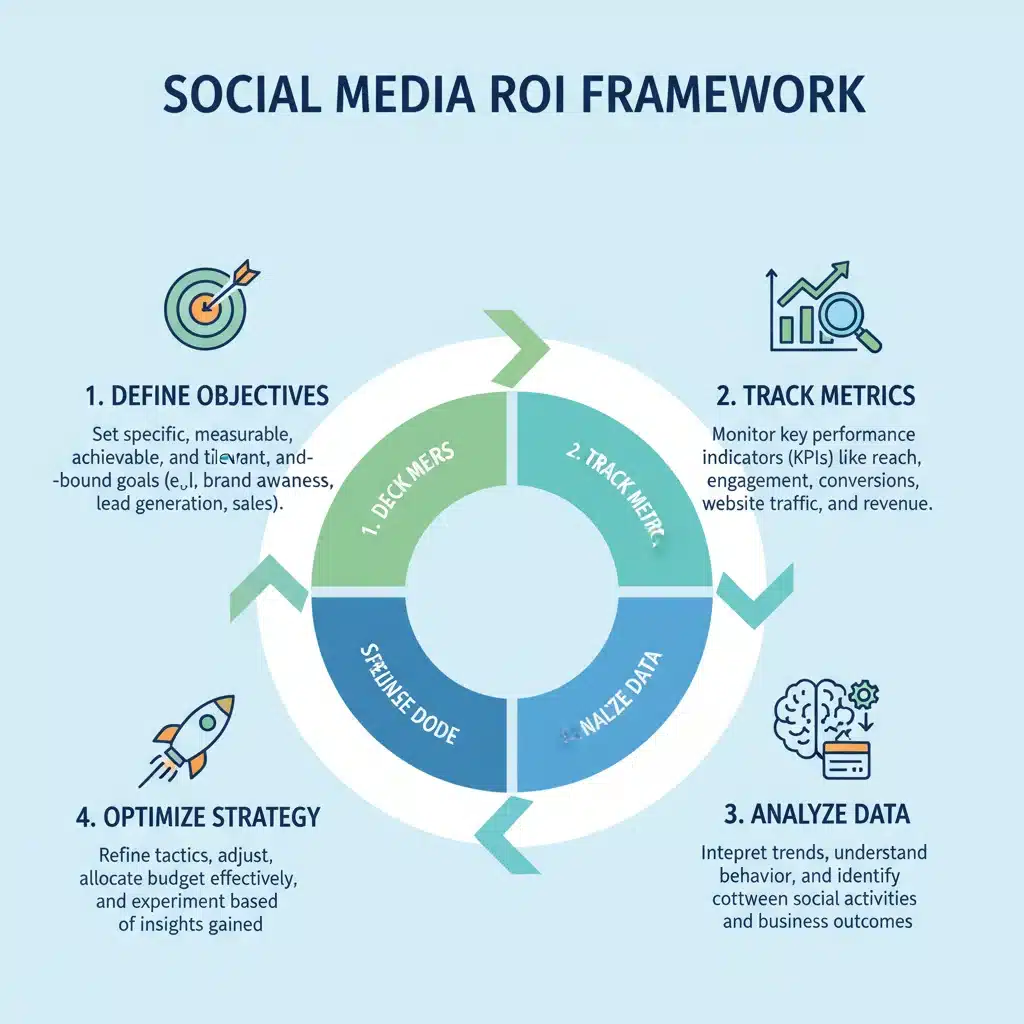
Many businesses struggle to quantify the impact of their social media activities, often leading to underfunded campaigns or, worse, misguided strategies. This article introduces a robust, 4-step framework designed to help U.S. businesses not only measure their social media ROI effectively but also optimize their strategies for significant growth by Q2 2026. This isn’t just about vanity metrics; it’s about connecting every like, share, and comment to your bottom line. By adopting this framework, you can transform your social media from a cost center into a powerful revenue driver.
Anúncios
We’ll delve into defining clear objectives, selecting the right metrics, analyzing data with precision, and continuously optimizing your campaigns. This comprehensive guide will equip you with the knowledge and tools to confidently answer the perennial question: ‘What is our social media ROI?’
The Crucial Importance of Social Media ROI for U.S. Businesses
Before we dive into the framework, let’s underscore why mastering social media ROI is non-negotiable for U.S. businesses. The U.S. market is characterized by its vastness, diversity, and rapid technological adoption. Consumers are increasingly spending more time on social platforms, making these channels indispensable for reaching target audiences. However, the sheer volume of content and competition means that simply posting is insufficient. Businesses must demonstrate that their social media investments are yielding positive returns, justifying budgets and securing future resources.
Anúncios
Without a clear understanding of social media ROI, businesses risk making decisions based on assumptions rather than data. This can lead to wasted ad spend, ineffective content strategies, and missed opportunities. On the other hand, a strong grasp of ROI allows businesses to:
- Justify Marketing Spend: Clearly demonstrate the financial impact of social media campaigns to stakeholders.
- Optimize Resource Allocation: Identify which platforms and strategies deliver the best returns, allowing for more efficient budget allocation.
- Improve Campaign Effectiveness: Understand what resonates with your audience and what drives desired actions, leading to more impactful campaigns.
- Gain Competitive Advantage: Businesses that can effectively measure and optimize their social media ROI are better positioned to outperform competitors.
- Drive Strategic Growth: Align social media efforts directly with overarching business goals, fostering sustainable growth.
For U.S. businesses aiming for growth by Q2 2026, integrating a robust ROI measurement framework isn’t just good practice; it’s a strategic imperative. It moves social media from a nebulous activity to a quantifiable, results-driven function of your marketing ecosystem.
Step 1: Define Clear, Measurable Objectives (SMART Goals)
The foundation of any successful social media ROI measurement strategy is the establishment of clear, measurable objectives. Without knowing what you aim to achieve, it’s impossible to determine if your efforts have been successful. These objectives should be SMART: Specific, Measurable, Achievable, Relevant, and Time-bound.
Specific
Instead of a vague goal like “increase brand awareness,” aim for something specific: “increase brand mentions on Twitter by 20%.” Specificity provides a clear target.
Measurable
Your objectives must be quantifiable. How will you track progress? For example, “drive 500 new leads from LinkedIn” is measurable, whereas “get more leads” is not.
Achievable
While ambition is good, your goals should be realistic given your resources, budget, and market conditions. Setting unattainable goals can demotivate your team and skew your ROI calculations.
Relevant
Social media objectives should align directly with your broader business goals. If your overall business goal is to increase online sales, then your social media objective might be “increase e-commerce conversions from Instagram by 15%.”
Time-bound
Every objective needs a deadline. This creates urgency and provides a clear period for evaluation. For instance, “increase website traffic from social media by 25% by the end of Q4 2025.”
Examples of SMART social media objectives for U.S. businesses:
- Brand Awareness: Increase organic reach on Facebook by 30% among users in key metropolitan areas by Q3 2025.
- Lead Generation: Generate 1,000 qualified leads through LinkedIn lead gen forms, resulting in a 10% conversion rate to sales, by Q1 2026.
- Customer Engagement: Boost average engagement rate (likes, comments, shares) on Instagram posts by 15% within the next six months.
- Website Traffic: Increase referral traffic to the company website from Pinterest by 20% month-over-month for the next quarter.
- Sales/Conversions: Drive $50,000 in direct sales attributed to social media campaigns (e.g., shoppable posts, direct ad conversions) by Q2 2026.
- Customer Service/Retention: Reduce customer support inquiry response time on Twitter by 50% and improve customer satisfaction scores (CSAT) related to social interactions by 10% by year-end.
By meticulously defining these objectives, U.S. businesses lay a solid groundwork for accurately measuring their social media ROI. This step is crucial because it dictates which metrics you will track and how you will interpret your data.
Step 2: Track the Right Metrics and Assign Monetary Values
Once your objectives are clearly defined, the next critical step in maximizing your social media ROI is to identify and track the specific metrics that directly correlate with those objectives. Not all metrics are created equal; focusing on vanity metrics (like total followers) without linking them to business outcomes can be misleading. Instead, prioritize metrics that contribute to your SMART goals and, crucially, assign monetary values where possible.
Key Categories of Metrics:
- Awareness Metrics:
- Reach: The number of unique users who saw your content.
- Impressions: The total number of times your content was displayed.
- Brand Mentions: How often your brand is mentioned across social platforms (can be tracked using social listening tools).
- Follower Growth: While a vanity metric on its own, consistent growth can indicate increasing brand visibility.
- Engagement Metrics:
- Likes, Comments, Shares: Indicate how much your audience interacts with your content.
- Engagement Rate: (Total engagements / Total followers) x 100 or (Total engagements / Reach) x 100.
- Click-Through Rate (CTR): The percentage of people who clicked on a link in your post.
- Time Spent: How long users spend interacting with your content (e.g., watching a video).
- Conversion Metrics:
- Website Clicks/Traffic: Users directed from social media to your website.
- Lead Generation: Number of leads acquired directly through social media (e.g., form submissions, direct messages).
- Sales/Revenue: Direct sales attributed to social media campaigns (e.g., using UTM parameters and conversion tracking).
- Cost Per Acquisition (CPA): The cost to acquire a new customer through social media.
- Conversion Rate: Percentage of social media users who complete a desired action (e.g., purchase, sign-up).
- Customer Loyalty/Advocacy Metrics:
- Customer Retention Rate: How many customers acquired via social media remain customers over time.
- Customer Lifetime Value (CLV): The projected total revenue that a customer will generate over their lifetime.
- Referrals: Number of new customers acquired through social media referrals.
Assigning Monetary Values: The Heart of Social Media ROI
This is where social media tracking moves beyond simple reporting and becomes a true ROI calculation. For each key action driven by social media, you need to assign a monetary value. This can be challenging but is essential for robust ROI analysis.
- Lead Value: If a lead typically converts to a sale at a certain rate and average sale value, you can calculate the monetary value of a lead. For example, if 10% of leads become customers, and your average sale is $1,000, then each lead is worth $100.
- Website Traffic Value: If your website traffic generates revenue (e.g., through ads, affiliate links, or direct sales), you can assign a value per visit. Alternatively, you can compare it to the cost of acquiring similar traffic through paid search.
- Brand Awareness Value: This is harder to quantify but can be estimated by comparing it to the cost of achieving similar reach and impressions through traditional advertising channels (e.g., PR or display ads). Tools like Google Analytics and social media platforms’ own analytics dashboards can help track this.
- Customer Service Savings: If social media reduces call center volume, estimate the cost savings per deflected call.
- Direct Sales: The most straightforward, as these are actual revenue figures. Ensure robust tracking with UTM parameters and pixel tracking.
Tools for Tracking:
- Google Analytics: Essential for tracking website traffic, conversions, and user behavior originating from social media.
- Native Social Media Analytics: Facebook Insights, Instagram Insights, Twitter Analytics, LinkedIn Analytics all provide valuable data on reach, engagement, and audience demographics.
- UTM Parameters: Custom tags added to URLs to track the source, medium, and campaign that referred traffic to your website.
- CRM Systems: Integrate social leads and customer data to track their journey and lifetime value.
- Social Listening Tools: For tracking brand mentions, sentiment, and competitive analysis.
- Conversion Pixels: For tracking specific actions taken on your website after users click through from social ads.
By meticulously tracking these metrics and diligently assigning monetary values, U.S. businesses can build a comprehensive understanding of the financial contributions of their social media efforts, making the calculation of social media ROI a much clearer process.
Step 3: Analyze Data and Calculate Your Social Media ROI
With objectives defined and metrics tracked, the next crucial step is to analyze the collected data and formally calculate your social media ROI. This is where you connect your social media activities to their financial outcomes, providing a clear picture of their profitability.
The Basic ROI Formula:
The standard formula for ROI is:
ROI = (Net Profit from Social Media / Total Social Media Investment) x 100
Let’s break down each component:
- Net Profit from Social Media: This is the total monetary value generated by your social media efforts (e.g., direct sales, lead value, brand awareness value, customer service savings) minus the total social media investment.
- Total Social Media Investment: This includes all costs associated with your social media activities. Be comprehensive here:
- Labor Costs: Salaries of social media managers, content creators, community managers, designers, etc.
- Ad Spend: All money spent on paid social media campaigns.
- Tools & Software: Subscriptions for social media management platforms, analytics tools, design software, etc.
- Content Creation Costs: Costs for photography, videography, copywriting, influencer collaborations.
- Agency Fees: If you outsource your social media.
Putting it into Practice: An Example for a U.S. Business
Imagine a U.S. e-commerce business running an Instagram campaign to boost sales for a new product line. Their objective is to drive direct sales.
- Total Social Media Investment for the Campaign:
- Ad Spend: $5,000
- Content Creation (photos/videos): $1,500
- Social Media Manager’s Time (allocated to campaign): $1,000
- Total Investment: $7,500
- Monetary Value Generated:
- Direct Sales attributed to Instagram: $15,000
- Estimated Value of new email subscribers captured (from Instagram links, based on average customer lifetime value): $2,000
- Total Revenue Generated: $17,000
- Net Profit: $17,000 (Revenue) – $7,500 (Investment) = $9,500
- ROI Calculation: ($9,500 / $7,500) x 100 = 126.67%
A 126.67% social media ROI indicates that for every dollar invested, the business generated $1.26 in profit. This is a very positive return.
Beyond the Basic Formula: Deeper Analysis
- Segmented ROI: Calculate ROI for different platforms (Facebook vs. LinkedIn), different campaign types (awareness vs. conversion), or different audience segments. This helps identify where your efforts are most effective.
- Attribution Models: Understand how social media contributes to the customer journey, even if it’s not the last touchpoint. First-touch, last-touch, linear, and time-decay attribution models can provide different insights. Google Analytics and many CRM systems offer these capabilities.
- Benchmarking: Compare your ROI against industry averages or your own historical performance. What’s considered a good social media ROI can vary significantly by industry and business goals.
- Qualitative Data: Don’t overlook the power of qualitative feedback. Comments, sentiment analysis, and direct customer feedback can provide context to your quantitative data, explaining why certain campaigns performed well or poorly.
The analysis phase is not just about crunching numbers; it’s about understanding the story behind those numbers. It’s about identifying trends, recognizing patterns, and drawing actionable conclusions that will inform your future social media strategy. For U.S. businesses, this rigorous analysis is key to staying competitive and achieving those Q2 2026 growth targets.

Step 4: Optimize and Iterate for Continuous Improvement
Calculating your social media ROI isn’t a one-time event; it’s an ongoing process of optimization and iteration. The digital landscape, particularly in the U.S. market, is constantly evolving, with new trends, algorithms, and consumer behaviors emerging regularly. To maintain and improve your ROI, a continuous cycle of analysis, adjustment, and re-evaluation is essential.
Key Optimization Strategies:
- A/B Testing:
- Content Formats: Test different types of content (images, videos, carousels, text-only posts) to see which performs best for specific objectives.
- Ad Creatives & Copy: Experiment with different headlines, body copy, calls-to-action (CTAs), and visuals in your paid campaigns.
- Targeting: Refine your audience targeting based on demographics, interests, behaviors, and custom audiences to reach the most receptive users.
- Posting Times: Analyze when your audience is most active and engaged, and schedule your posts accordingly.
- Content Strategy Refinement:
- Leverage Top-Performing Content: Identify themes, topics, and formats that consistently achieve high engagement and conversions, and create more of that.
- Address Underperforming Content: Analyze why certain content fails and either eliminate it or pivot your approach.
- Audience Feedback: Pay attention to comments, direct messages, and sentiment analysis. What are your followers asking for? What problems can you solve for them?
- Platform-Specific Optimization:
- Each social media platform has its unique nuances and best practices. Optimize your content and strategy for each platform where your target audience resides. For example, short-form video on TikTok and Reels, professional networking on LinkedIn, visual storytelling on Instagram, and real-time updates on X (Twitter).
- Budget Reallocation:
- Based on your ROI analysis, reallocate your social media budget to campaigns, platforms, or content types that are delivering the highest returns. Shift resources away from underperforming areas.
- Technology & Tool Adoption:
- Stay updated with the latest social media management, analytics, and automation tools that can streamline your processes and provide deeper insights. AI-powered tools, for instance, can help with content generation, scheduling, and sentiment analysis.
- Stay Ahead of Trends:
- The U.S. social media landscape is dynamic. Keep an eye on emerging platforms, new content formats (e.g., live audio, interactive polls), and shifts in consumer behavior. Being an early adopter of relevant trends can provide a significant competitive edge.
- Regular Reporting and Review:
- Establish a consistent schedule for reviewing your social media ROI (monthly, quarterly). Share these reports with your team and stakeholders to foster transparency and collective ownership of social media success. Use these reviews to set new, optimized SMART goals for the next period.
By embracing this iterative approach, U.S. businesses can continuously refine their social media strategies, ensuring that every dollar invested yields the maximum possible return. This commitment to ongoing optimization is what separates good social media performance from truly exceptional, ROI-driven growth, propelling you towards your Q2 2026 targets and beyond.
Common Challenges in Measuring Social Media ROI (and Solutions)
Even with a robust framework, U.S. businesses often encounter hurdles when trying to accurately measure social media ROI. Recognizing these challenges and having strategies to overcome them is key to success.
Challenge 1: Difficulty in Assigning Monetary Value to Non-Direct Conversions
Problem: It’s easy to track direct sales, but what about brand awareness, customer loyalty, or customer service interactions? These indirect contributions are harder to quantify financially.
Solution:
- Proxy Metrics: Use proxy metrics with established values. For example, if a website visit from social media typically leads to X revenue, assign that value. If increased brand mentions reduce future ad spend, estimate that saving.
- Lifetime Value (LTV): Focus on the long-term value of a customer acquired through social media. A customer who discovers your brand on social media might have a higher LTV due to increased engagement and loyalty.
- Comparative Cost: What would it cost to achieve the same level of brand awareness or customer service through traditional channels? Use this as a benchmark.
Challenge 2: Attribution Models Complexity
Problem: A customer might see your ad on Instagram, click a link on Twitter, and then convert via a Google search. How do you attribute the sale?
Solution:
- Multi-Touch Attribution: Don’t rely solely on last-click attribution. Explore models like linear (distributes credit equally across all touchpoints), time decay (gives more credit to recent touchpoints), or U-shaped (credits first and last touchpoints more).
- Integrated Data: Use a robust analytics platform (like Google Analytics 4) and CRM system that can integrate data from various sources to provide a holistic view of the customer journey.
- UTM Parameters: Consistently use UTM parameters on all social media links to accurately track traffic sources.
Challenge 3: Rapidly Changing Social Media Landscape
Problem: Algorithms change, new features emerge, and audience behaviors shift constantly, making it hard to maintain consistent measurement.
Solution:
- Stay Agile: Be prepared to adapt your strategy and measurement approach. Regularly review platform updates and industry news.
- Focus on Fundamentals: While platforms evolve, the core principles of understanding your audience, delivering value, and measuring impact remain constant.
- Invest in Training: Ensure your team is continuously educated on the latest social media trends and measurement techniques.
Challenge 4: Data Overload and Lack of Actionable Insights
Problem: Social media platforms and analytics tools generate vast amounts of data, but extracting meaningful, actionable insights can be overwhelming.
Solution:
- Focus on SMART Goals: Only track metrics directly relevant to your objectives. Filter out the noise.
- Dashboards and Visualization: Create clear, concise dashboards that highlight key performance indicators (KPIs) and ROI calculations. Tools like Google Data Studio or specialized social media reporting tools can help.
- Regular Reviews: Schedule dedicated time for data analysis and discussion. Don’t just collect data; interpret it.
Challenge 5: Small Budgets and Limited Resources
Problem: Smaller U.S. businesses might not have the budget for expensive tools or dedicated analytics teams.
Solution:
- Leverage Free Tools: Utilize native platform analytics, Google Analytics, and free versions of social listening tools.
- Prioritize: Focus on 1-2 core social media platforms where your audience is most active and measure only the most critical metrics first.
- Manual Tracking: For very small operations, basic spreadsheets can track key data points and costs.
By proactively addressing these challenges, U.S. businesses can build more resilient and effective social media ROI measurement systems, ensuring their efforts contribute meaningfully to their growth objectives by Q2 2026.
Future-Proofing Your Social Media ROI Strategy for the U.S. Market
As we look towards Q2 2026 and beyond, the dynamics of social media marketing in the U.S. market will undoubtedly continue to evolve. To ensure your social media ROI strategy remains effective and drives sustained growth, it’s crucial to adopt a forward-thinking approach. This involves anticipating future trends and integrating them into your measurement and optimization processes.
Embrace AI and Machine Learning
Artificial intelligence and machine learning are rapidly transforming social media. These technologies can:
- Automate Data Analysis: AI tools can process vast datasets, identify patterns, and highlight actionable insights faster than human analysts.
- Predictive Analytics: Forecast campaign performance, audience behavior, and potential ROI based on historical data.
- Personalized Content: AI-driven content recommendations can increase engagement and conversion rates, directly impacting ROI.
- Enhanced Targeting: AI can refine audience segmentation and ad placement for maximum efficiency.
U.S. businesses should explore integrating AI-powered analytics platforms and content creation tools to gain a competitive edge and optimize their social media ROI.
Focus on First-Party Data
With increasing privacy regulations and the eventual deprecation of third-party cookies, first-party data will become even more valuable. Collect data directly from your audience through:
- Website Interactions: Use your own analytics and tracking pixels.
- Email Sign-ups: Build your email lists through social media calls-to-action.
- CRM Systems: Integrate social interactions with your customer relationship management data.
- Surveys and Quizzes: Directly ask your audience for preferences and feedback.
Leveraging first-party data allows for more accurate targeting, personalized experiences, and ultimately, a clearer understanding of your social media ROI without relying on external data sources.
Prioritize Community Building and Authentic Engagement
While direct conversions are vital, the long-term value of social media often lies in building strong, engaged communities. Future ROI strategies will increasingly recognize and measure the value of:
- Brand Advocacy: Customers who become advocates for your brand, generating organic reach and trust.
- User-Generated Content (UGC): Content created by your customers, which is often more authentic and influential than brand-produced content.
- Customer Loyalty: Engaged communities lead to higher retention and lifetime value.
Develop metrics to track these aspects, such as brand sentiment, UGC volume, and repeat purchase rates from social-first customers, to capture a more holistic social media ROI.
Experiment with New Social Commerce and Immersive Experiences
The lines between social media and e-commerce are blurring. U.S. consumers are increasingly comfortable making purchases directly on social platforms. Explore:
- Live Shopping: Host live video events where customers can purchase products in real-time.
- In-App Shopping Features: Utilize Instagram Shops, Facebook Marketplace, and other native commerce tools.
- Augmented Reality (AR) Filters: Allow customers to virtually try on products or visualize them in their space, enhancing the shopping experience.
These direct commerce opportunities offer highly measurable ROI, making it easier to attribute sales directly to social media efforts.
Emphasize Ethical and Transparent Practices
Consumers in the U.S. are increasingly concerned about data privacy and ethical marketing. Maintaining transparency and building trust on social media will be paramount:
- Clear Disclosures: For influencer marketing and sponsored content.
- Data Privacy Compliance: Adhere to all relevant data protection regulations (e.g., CCPA).
- Authenticity: Be genuine in your interactions and avoid manipulative tactics.
A damaged reputation due to unethical practices can severely impact brand perception and, consequently, your long-term social media ROI.
By integrating these forward-looking strategies, U.S. businesses can not only meet their Q2 2026 growth objectives but also build a resilient and adaptable social media presence that consistently delivers strong ROI in an ever-changing digital world.
Conclusion: Driving Tangible Growth with Social Media ROI
Measuring social media ROI is no longer an optional endeavor for U.S. businesses; it’s a fundamental requirement for strategic growth and sustained success in a competitive digital landscape. By systematically applying the 4-step framework—defining clear objectives, tracking relevant metrics with assigned monetary values, rigorously analyzing data, and continuously optimizing your strategies—you can transform your social media efforts from an ambiguous expense into a powerful and quantifiable revenue engine.
This framework provides a clear roadmap to connect every social media interaction to your bottom line, enabling you to make data-driven decisions that justify your investments and significantly impact your business goals. For U.S. businesses aiming to achieve ambitious growth targets by Q2 2026, embracing this structured approach to social media ROI is the key to unlocking its full potential.
Remember, social media is a dynamic environment. The businesses that thrive are those that are not only adept at current strategies but also agile enough to adapt to future trends, leveraging AI, first-party data, authentic community building, and emerging social commerce opportunities. By committing to continuous measurement and optimization, you empower your brand to not just participate in the social conversation but to lead it, driving tangible results and solidifying your market position. Start implementing this framework today, and watch your social media investments yield unprecedented returns.