Navigating AI Ethics: Top Challenges for US Businesses in 2026

Anúncios
The 3 Biggest AI Ethics Challenges for U.S. Businesses in 2026: An Insider’s Guide to Compliance
As we hurtle towards 2026, Artificial Intelligence (AI) continues its relentless march into every facet of business operations, promising unprecedented efficiency, innovation, and growth. However, this transformative power comes with a significant caveat: a rapidly evolving landscape of AI Ethics Challenges. For U.S. businesses, understanding and proactively addressing these ethical dilemmas isn’t just about good corporate citizenship; it’s about safeguarding reputation, ensuring legal compliance, and fostering sustainable growth in an increasingly AI-driven world. The stakes are higher than ever, and those who fail to adapt risk not only financial penalties but also a catastrophic erosion of public trust.
Anúncios
The year 2026 is poised to be a critical juncture. Regulatory bodies are catching up, consumer awareness is at an all-time high, and the technological capabilities of AI are advancing at an exponential rate. This confluence of factors creates a perfect storm where ethical considerations move from abstract philosophical discussions to concrete, operational imperatives. Businesses that once viewed AI ethics as a secondary concern will find it front and center, demanding strategic attention and robust compliance frameworks.
This comprehensive guide will delve into the three most significant AI Ethics Challenges that U.S. businesses will face in 2026: algorithmic bias, the imperative for explainable AI, and the complex issue of accountability. We’ll explore why these challenges are so pressing, their potential impact, and, most importantly, provide actionable strategies and best practices for compliance. Our goal is to equip you with the knowledge to navigate this intricate terrain, transforming potential pitfalls into opportunities for ethical leadership and competitive advantage.
1. Algorithmic Bias: The Silent Saboteur of Fairness and Equity
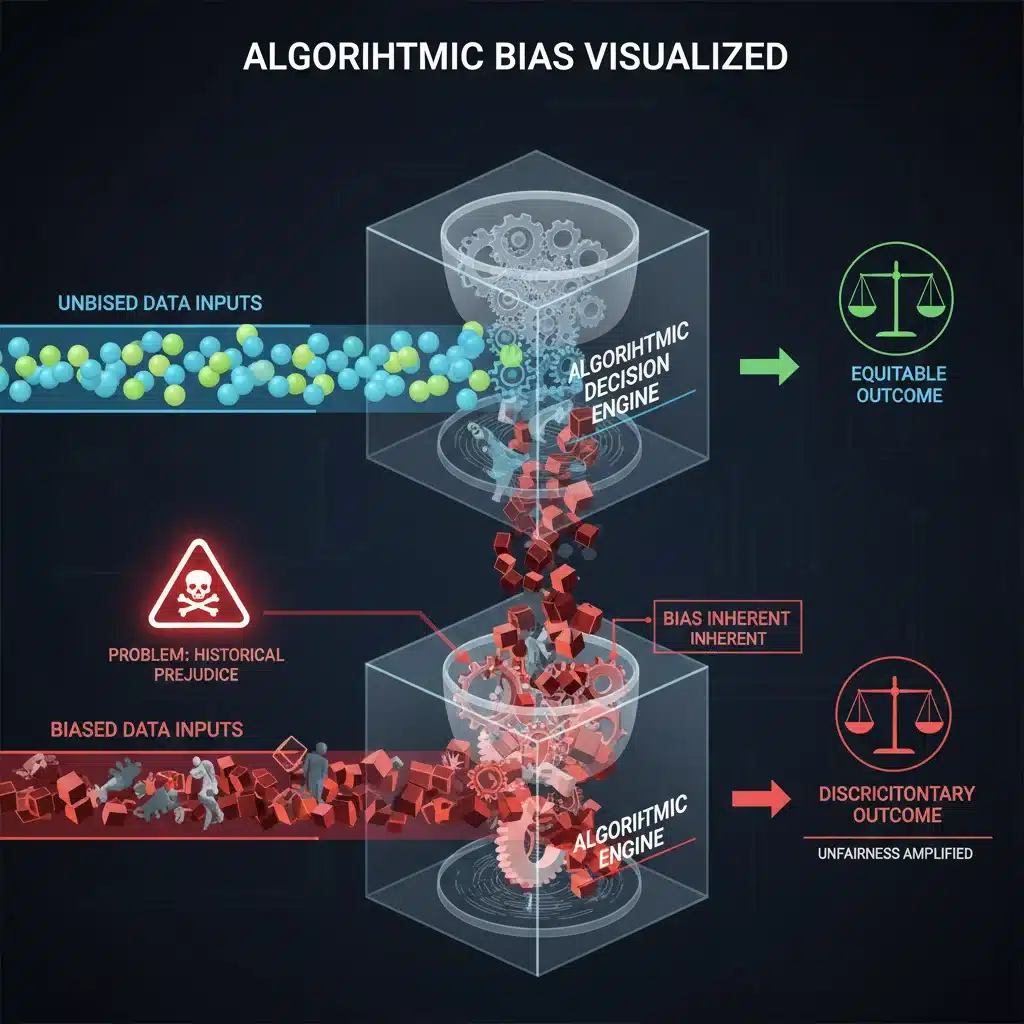
Algorithmic bias stands as perhaps the most insidious of the AI Ethics Challenges. It refers to systematic and repeatable errors in a computer system that create unfair outcomes, such as favoring one arbitrary group over others. This bias isn’t born of malicious intent from the AI itself; rather, it’s a direct reflection of the biased data it’s trained on, the flawed assumptions made during its development, or the subjective decisions embedded within its design. In 2026, as AI systems become more autonomous and pervasive, the potential for algorithmic bias to cause widespread harm will escalate dramatically.
Anúncios
Consider the implications across various sectors. In hiring, biased AI can perpetuate historical inequalities by discriminating against certain demographics, leading to lawsuits and a talent drain. In loan applications, discriminatory algorithms can deny credit to qualified individuals from marginalized communities, exacerbating economic disparities. In healthcare, biased diagnostic tools might misdiagnose or undertreat certain patient groups, leading to severe health outcomes. Even in seemingly innocuous applications like targeted advertising, algorithmic bias can reinforce stereotypes and limit opportunities for specific users.
The challenge is multifaceted. Firstly, identifying bias in complex AI models can be incredibly difficult. These systems often operate as ‘black boxes,’ making it hard to trace how a particular decision was reached. Secondly, even when identified, mitigating bias requires a deep understanding of data science, sociology, and ethical principles, often beyond the scope of a typical business’s internal expertise. Thirdly, the data itself is a moving target; what might be considered unbiased today could reveal inherent biases as societal norms evolve or new data patterns emerge.
Strategies for Mitigating Algorithmic Bias:
- Diverse Data Sourcing and Curation: The foundation of ethical AI is diverse, representative, and clean data. Businesses must invest in rigorous data auditing processes to identify and correct biases in training datasets. This includes not only demographic diversity but also ensuring data reflects a wide range of real-world scenarios and outcomes.
- Bias Detection and Monitoring Tools: Implement specialized tools and methodologies to continuously monitor AI models for emergent biases post-deployment. This involves setting up fairness metrics and thresholds, and regularly testing the model against various demographic groups to ensure equitable performance.
- Ethical AI Design Principles: Incorporate ‘fairness by design’ into the AI development lifecycle. This means involving ethics experts, social scientists, and diverse stakeholders from the initial conceptualization phase to ensure ethical considerations are baked into the architecture, not just patched on later.
- Regular Audits and Reviews: Conduct independent, third-party audits of AI systems to assess for bias. These audits should not only check for technical compliance but also evaluate the societal impact of the AI’s decisions.
- Transparency in Data Collection and Usage: Be transparent with users about what data is being collected and how it’s being used to train AI models. This fosters trust and allows for feedback that can help identify and rectify biases.
Addressing algorithmic bias is not a one-time fix but an ongoing commitment. It requires a cultural shift within organizations, prioritizing ethical considerations alongside technical performance. The businesses that master this will not only avoid legal repercussions but also build more robust, trustworthy, and ultimately more successful AI systems.
2. The Imperative for Explainable AI (XAI): Demystifying the Black Box
The second major item on the list of AI Ethics Challenges for 2026 is the demand for Explainable AI (XAI). As AI systems grow in complexity and influence, particularly those employing deep learning techniques, their decision-making processes often become opaque ‘black boxes.’ This lack of transparency poses significant ethical, legal, and operational problems, making XAI not just a technical aspiration but a business necessity.
Why is explainability so crucial? Firstly, for compliance. Emerging regulations, such as the EU’s AI Act and potential U.S. state-level legislation, increasingly mandate that individuals have the right to an explanation when an AI system makes a decision that significantly affects them. For instance, if an AI denies a loan, an insurance claim, or a job application, the applicant should be able to understand *why* that decision was made. Without XAI, businesses risk non-compliance, leading to hefty fines and legal battles.
Secondly, for trust and adoption. Users, whether they are customers, employees, or regulatory bodies, are less likely to trust and adopt AI systems they don’t understand. If an AI’s logic is inscrutable, it fosters suspicion and resistance. Conversely, an AI that can clearly articulate its reasoning builds confidence, encouraging wider and more effective deployment.
Thirdly, for debugging and improvement. When an AI system makes an error or produces a biased outcome, an opaque model makes it incredibly difficult to diagnose the root cause. XAI allows developers and data scientists to understand the internal workings of the model, pinpointing where biases might be introduced or where logic deviates from intended outcomes, thereby facilitating faster and more effective remediation.
Approaches to Achieving Explainable AI:
- Intrinsic Explainability: Design AI models that are inherently interpretable from the ground up. Simpler models like linear regression or decision trees are often more explainable than complex neural networks. While not always feasible for cutting-edge AI, prioritizing interpretability where possible is key.
- Post-hoc Explainability: For complex ‘black box’ models, develop techniques to explain their decisions *after* they have been made. This includes methods like LIME (Local Interpretable Model-agnostic Explanations) and SHAP (SHapley Additive exPlanations), which can provide insights into which features most influenced a particular prediction.
- User-Centric Explanations: The explanation must be tailored to the audience. A technical explanation suitable for a data scientist will not be appropriate for a customer. Businesses need to develop clear, concise, and understandable explanations for different stakeholders, often leveraging natural language generation or interactive visualization tools.
- Documentation and Audit Trails: Maintain comprehensive documentation of AI model development, including data sources, training methodologies, model architecture, and performance metrics. Implement robust audit trails that log every decision made by an AI system, along with the input data that led to it.
- Human-in-the-Loop Systems: Incorporate human oversight and intervention points within AI decision-making processes. This allows humans to review and, if necessary, override AI decisions, providing a crucial safeguard and an opportunity to understand where the AI might be faltering.
The journey towards XAI is challenging, requiring significant investment in research, development, and cross-disciplinary expertise. However, for U.S. businesses in 2026, it’s no longer an optional extra but a foundational requirement for ethical, legal, and commercially viable AI deployment. Embracing XAI will transform AI from a mysterious oracle into a trusted, transparent partner.
3. Accountability and Liability: Who is Responsible When AI Fails?
The third, and arguably most complex, of the AI Ethics Challenges is establishing clear accountability and liability when AI systems make errors, cause harm, or operate outside expected parameters. As AI becomes more autonomous and capable of making decisions with real-world consequences, the traditional legal and ethical frameworks for assigning responsibility are increasingly strained. By 2026, U.S. businesses will face intense pressure to define and implement robust accountability structures.
Consider a scenario where an autonomous vehicle, powered by AI, causes an accident. Is the software developer responsible? The vehicle manufacturer? The owner of the car? The company that supplied the training data? Or the AI itself? The lack of clear precedents creates a legal quagmire. Similarly, if an AI-powered medical device provides a flawed diagnosis, leading to patient harm, who bears the legal and ethical burden?
This challenge is exacerbated by several factors. The ‘black box’ nature of many AI systems (as discussed with XAI) makes it difficult to pinpoint the exact cause of a failure. The distributed nature of AI development, often involving multiple vendors, open-source components, and third-party data, further complicates the attribution of blame. Moreover, the adaptive and learning capabilities of AI mean that a system’s behavior can evolve over time, potentially diverging from its initial design and making retrospective analysis even harder.
Establishing Accountability Frameworks:
- Clear Roles and Responsibilities: Businesses must establish clear internal policies defining who is responsible at each stage of the AI lifecycle – from data collection and model development to deployment, monitoring, and maintenance. This includes assigning specific roles for ethical oversight.
- Risk Assessment and Management: Implement comprehensive AI risk assessment frameworks that identify potential harms, evaluate their likelihood and impact, and establish mitigation strategies. This should include legal, ethical, and reputational risks.
- Contractual Clarity with Vendors: When procuring AI solutions or components from third-party vendors, ensure contracts clearly delineate responsibilities and liabilities for potential AI failures. This requires robust due diligence on vendor ethical practices and transparency.
- Insurance and Legal Preparedness: Explore specialized AI liability insurance products as they become available. Work with legal counsel to understand existing product liability laws and how they might apply to AI, and prepare for potential litigation.
- Post-Mortem Analysis and Learning: Develop protocols for thoroughly investigating AI failures or adverse events. This includes forensic analysis of the AI’s decision-making process, identifying contributing factors, and implementing corrective actions to prevent recurrence.
- Ethical Review Boards: Establish internal or external ethical review boards composed of diverse experts (technologists, ethicists, legal counsel, social scientists) to scrutinize AI projects, assess potential risks, and advise on responsible deployment.
- Regulatory Engagement: Actively engage with emerging regulatory discussions and contribute to the development of legal frameworks for AI liability. Proactive engagement can help shape reasonable and effective regulations.
Ultimately, navigating the accountability challenge means moving beyond the idea of AI as an independent entity and recognizing it as a tool developed and deployed by humans. The onus of responsibility, therefore, falls squarely on the organizations and individuals who create, deploy, and manage these powerful systems. By 2026, robust accountability frameworks will be non-negotiable for any U.S. business leveraging AI.

The Path Forward: Building an Ethical AI Future
The three AI Ethics Challenges – algorithmic bias, the demand for explainable AI, and the complexities of accountability – are not isolated issues but deeply interconnected facets of responsible AI deployment. Addressing one often aids in mitigating another. For instance, achieving greater explainability can significantly help in identifying and rectifying algorithmic bias, which in turn clarifies accountability.
For U.S. businesses looking towards 2026 and beyond, a holistic and proactive approach to AI ethics is paramount. This isn’t just about avoiding penalties; it’s about building a foundation of trust that is essential for the long-term success and societal acceptance of AI technologies. Businesses that embrace ethical AI as a core strategic pillar will gain a significant competitive advantage, attracting top talent, fostering customer loyalty, and demonstrating leadership in a rapidly evolving technological landscape.
Key Takeaways for Compliance and Leadership:
- Integrate Ethics into AI Strategy: Embed ethical considerations from the very outset of any AI project, rather than treating them as an afterthought.
- Invest in Ethical AI Expertise: Develop internal capabilities in AI ethics, data governance, and responsible AI development, or partner with external experts.
- Foster a Culture of Responsibility: Promote an organizational culture where ethical considerations are valued and openly discussed at all levels, from leadership to individual developers.
- Embrace Continuous Learning and Adaptation: The AI ethics landscape is dynamic. Stay abreast of emerging research, best practices, and regulatory developments to continually adapt your strategies.
- Prioritize Transparency and Communication: Be open with stakeholders about your AI practices, including how data is used, how decisions are made, and what safeguards are in place.
The future of AI is not just about what technology can do, but what it should do. By diligently addressing the AI Ethics Challenges outlined here, U.S. businesses can shape an AI future that is not only innovative and prosperous but also fair, transparent, and accountable. The time to act is now, laying the groundwork for a responsible AI ecosystem that benefits everyone.