
The 3 Biggest AI Breakthroughs Transforming US Industries by Q3 2026: An Insider’s Guide to Adoption
The landscape of United States industries is on the precipice of a monumental shift, driven by the relentless pace of artificial intelligence innovation. As we approach Q3 2026, several key AI breakthroughs are not just incremental improvements but foundational changes set to redefine operational efficiencies, market dynamics, and competitive advantages across various sectors. This article delves into the three most impactful AI breakthroughs, offering an insider’s guide to understanding their implications and, crucially, how US industries can strategically adopt them to thrive in the coming years. The ongoing AI Industry Transformation is not a distant future; it is unfolding now, and proactive engagement is paramount for survival and success.
Anúncios
The promise of AI has always been vast, but only recently have we seen the convergence of computational power, data availability, and algorithmic sophistication reach a critical mass, enabling truly transformative applications. Businesses that fail to recognize and adapt to these shifts risk obsolescence, while those that embrace them stand to gain unprecedented levels of productivity, innovation, and market leadership. Our focus here is to dissect these advancements, providing actionable insights for businesses navigating this exhilarating, yet challenging, era of AI Industry Transformation.
Breakthrough 1: Hyper-Personalized AI and Predictive Customer Experience
The first major breakthrough revolutionizing US industries is the advent of hyper-personalized AI, coupled with significantly advanced predictive analytics for customer experience. This isn’t just about recommending products; it’s about anticipating individual customer needs, preferences, and even emotional states with remarkable accuracy, leading to truly bespoke interactions across all touchpoints. By Q3 2026, this technology will move beyond niche applications to become a standard in retail, finance, healthcare, and entertainment.
What Defines Hyper-Personalized AI Now?
Previous generations of personalization relied on broad segmentation and rule-based systems. Today’s hyper-personalized AI leverages deep learning models, natural language processing (NLP), and computer vision to analyze vast, disparate datasets – including browsing history, purchase patterns, social media activity, real-time sentiment analysis, and even biometric data (with consent). This allows for dynamic, real-time adaptation of services, content, and communications. Imagine a financial institution offering highly tailored investment advice based on a customer’s current life stage, spending habits, and stated financial goals, all updated instantaneously. Or a healthcare provider customizing wellness plans and preventive care recommendations based on genetic predispositions, lifestyle data from wearables, and environmental factors.
Anúncios
Impact on US Industries
- Retail and E-commerce: Beyond product recommendations, AI will curate entire shopping experiences, from personalized storefront layouts to dynamic pricing and proactive customer service. This will lead to increased conversion rates, higher customer lifetime value, and reduced churn. The ability to predict fashion trends or consumer electronics demand with greater accuracy will also optimize inventory management.
- Healthcare: Patient engagement will be revolutionized. AI-powered virtual assistants will provide personalized health coaching, medication reminders, and symptom checkers, easing the burden on human staff and improving patient outcomes. Predictive analytics will identify at-risk patients for proactive intervention, enhancing preventive care.
- Financial Services: Banks and investment firms will offer hyper-personalized financial planning, fraud detection with fewer false positives, and tailored product offerings that evolve with the customer’s financial journey. This builds stronger customer loyalty and trust.
- Media and Entertainment: Content platforms will move beyond genre-based recommendations to truly understanding individual taste profiles, curating unique viewing or listening experiences, and even influencing content creation based on predicted audience engagement.
Adoption Strategies for Businesses
To successfully integrate hyper-personalized AI, businesses must prioritize several key areas:
- Data Infrastructure Modernization: This AI thrives on data. Companies need robust, integrated data lakes and warehouses capable of handling diverse data types in real-time. Data governance and privacy protocols are non-negotiable.
- Ethical AI Frameworks: Transparency in how AI uses customer data and clear consent mechanisms are crucial. Building trust is paramount. Companies must establish ethical guidelines to prevent bias and ensure fair treatment.
- Talent Development: Investing in data scientists, AI engineers, and UX designers with an understanding of AI-driven personalization is essential. Existing staff will require training to interact with and leverage these new tools.
- Phased Implementation: Start with pilot programs in specific customer segments or product lines, gather feedback, and iterate. A ‘big bang’ approach can be overwhelming and counterproductive.
The AI Industry Transformation driven by hyper-personalization is about moving from a one-size-fits-all approach to a unique, individual-centric engagement model, fostering deeper customer relationships and driving unprecedented growth.
Breakthrough 2: Advanced AI-Driven Autonomous Systems and Collaborative Robotics
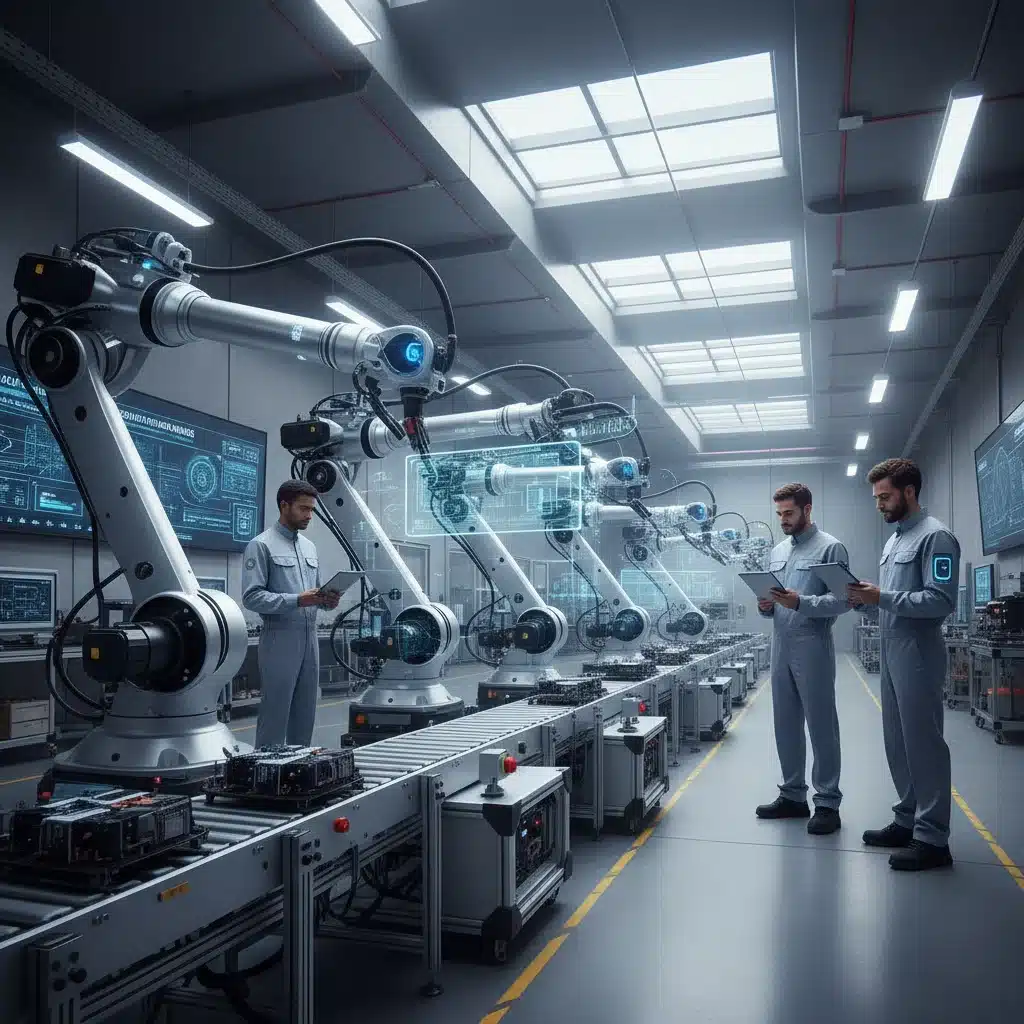
The second major breakthrough is the maturation of AI-driven autonomous systems and collaborative robotics (cobots). While robotics have been present in manufacturing for decades, the new wave, powered by advanced AI, machine learning, and improved sensor technology, brings unprecedented levels of adaptability, dexterity, and the ability to work seamlessly alongside humans. By Q3 2026, these systems will be integral not just in factories but also in logistics, agriculture, healthcare, and even service industries.
Evolution of Autonomous Systems
The distinction lies in intelligence. Older robots performed repetitive, pre-programmed tasks. Today’s AI-driven autonomous systems can learn from their environment, adapt to unforeseen circumstances, and make real-time decisions. Cobots, in particular, are designed with safety features and intuitive interfaces to share workspaces with humans, augmenting human capabilities rather than simply replacing them. They can handle complex assembly tasks, quality control inspections with microscopic precision, or even assist in delicate surgical procedures.
Impact on US Industries
- Manufacturing: Enhanced automation leads to higher production efficiency, reduced waste, and improved product quality. Cobots can take over dangerous or monotonous tasks, freeing human workers for more complex, creative, and supervisory roles. This addresses labor shortages and boosts global competitiveness.
- Logistics and Supply Chain: Autonomous forklifts, drones for inventory management, and intelligent sorting systems will optimize warehouse operations, speed up delivery times, and reduce operational costs. Predictive maintenance for these systems, powered by AI, ensures minimal downtime.
- Agriculture: AI-powered autonomous tractors, drones for crop monitoring, and robotic harvesters will increase yields, reduce resource consumption (water, pesticides), and make farming more sustainable and efficient.
- Healthcare: Robots can assist in surgeries, dispense medication, transport supplies, and even help with patient rehabilitation, improving care quality and operational efficiency in hospitals.
Adoption Strategies for Businesses
Implementing advanced AI-driven autonomous systems requires a strategic approach:
- Workforce Reskilling: This is critical. Companies must invest in training programs to equip their workforce with the skills needed to operate, maintain, and collaborate with these new technologies. This fosters a positive transition and minimizes job displacement concerns.
- Safety and Integration Planning: Thorough risk assessments and careful integration planning are vital, especially when cobots work alongside humans. Interoperability with existing IT and operational technology (OT) systems is also key.
- Scalable Infrastructure: Ensure that the underlying IT infrastructure can support the data processing and connectivity demands of these intelligent systems. Edge AI will play a significant role in enabling real-time decision-making.
- Regulatory Compliance: Stay abreast of evolving regulations concerning autonomous systems, especially in areas like safety, data privacy, and ethical deployment.
This aspect of AI Industry Transformation is about augmenting human potential and creating smarter, safer, and more productive work environments, driving a new era of industrial efficiency and innovation.
Breakthrough 3: Generative AI for Accelerated Innovation and Content Creation
The third transformative breakthrough is the widespread adoption and sophistication of generative AI. Beyond merely analyzing data, generative AI can create novel content, designs, code, and even scientific hypotheses. By Q3 2026, its impact will be felt across creative industries, R&D, software development, and strategic planning, fundamentally altering how businesses innovate and produce.
The Power of Generative AI
Generative AI models, such as advanced Large Language Models (LLMs) and diffusion models, can understand context, learn patterns from vast datasets, and then generate new, original outputs. This includes writing complex code, drafting marketing copy, designing new product prototypes, composing music, creating realistic images and videos, and even simulating complex scientific experiments. The key is its ability to accelerate the ideation and creation phases, significantly shortening development cycles and reducing costs.
Impact on US Industries
- Software Development: Generative AI can write, debug, and optimize code, accelerating software development cycles and allowing human developers to focus on higher-level architectural design and complex problem-solving. This addresses the ongoing demand for skilled developers.
- Marketing and Advertising: AI can generate personalized ad copy, create entire marketing campaigns, design compelling visuals, and even produce synthetic media tailored to specific demographics, all at unprecedented speed and scale.
- Product Design and Engineering: From architectural blueprints to industrial product designs, generative AI can explore thousands of design iterations based on specified constraints (e.g., material, cost, performance), leading to optimized and innovative solutions faster than traditional methods.
- Research and Development: AI can generate hypotheses, design experiments, synthesize research papers, and even simulate molecular structures for drug discovery, significantly accelerating scientific breakthroughs.
- Education and Training: Personalized learning materials, adaptive assessments, and even virtual tutors can be generated by AI, revolutionizing how knowledge is disseminated and acquired.
Adoption Strategies for Businesses
To harness the power of generative AI, businesses should consider:
- Human-in-the-Loop Integration: Generative AI is a powerful tool, but it requires human oversight and refinement. Establish workflows where AI generates initial drafts or designs, and human experts review, edit, and provide strategic direction.
- Data Curation and Fine-tuning: The quality of AI-generated output heavily depends on the quality and relevance of the data it’s trained on. Businesses need to curate proprietary datasets and fine-tune models to align with their specific brand voice, technical requirements, or research objectives.
- Intellectual Property and Ethics: Address concerns around copyright, intellectual property, and potential misuse of AI-generated content. Clear policies and legal frameworks are essential.
- Pilot Projects for Creative & R&D Teams: Introduce generative AI tools to creative, marketing, and R&D teams through pilot projects to demonstrate value and build internal expertise. Encourage experimentation in a controlled environment.
The AI Industry Transformation through generative AI is about democratizing creation and accelerating the pace of innovation, allowing businesses to explore new possibilities and bring ideas to fruition at an unparalleled speed.

Overcoming Challenges in AI Adoption
While the opportunities presented by these AI breakthroughs are immense, their adoption is not without challenges. US industries must proactively address several key hurdles:
- Data Security and Privacy: With increased reliance on data, robust cybersecurity measures and strict adherence to privacy regulations (e.g., GDPR, CCPA) are non-negotiable. Data breaches can erode trust and incur significant penalties.
- Talent Gap: The demand for AI specialists far outstrips supply. Companies must invest in upskilling existing employees and collaborating with educational institutions to build a future-ready workforce.
- Ethical AI Development: Ensuring AI systems are fair, transparent, and unbiased is crucial. Developing ethical AI guidelines and implementing accountability frameworks will be vital to prevent societal harm and maintain public trust.
- Integration Complexity: Integrating new AI systems with legacy IT infrastructure can be complex and costly. A phased approach, strong project management, and a focus on interoperability are essential.
- Cost of Implementation: Initial investments in AI technologies, infrastructure, and talent can be substantial. Businesses need clear ROI projections and strategic funding to justify these expenditures.
- Resistance to Change: Human factors often pose the biggest challenge. Employees may fear job displacement or resist new workflows. Effective change management, clear communication, and demonstrating the benefits of AI to the workforce are critical for successful adoption.
Navigating these challenges requires a holistic strategy that encompasses technology, people, processes, and governance. The AI Industry Transformation demands not just technological prowess but also organizational agility and a commitment to ethical deployment.
The Future Beyond Q3 2026: Continued AI Industry Transformation
The breakthroughs discussed here are merely milestones in an ongoing journey. Beyond Q3 2026, we can anticipate even more profound developments. Quantum AI, for instance, promises to unlock computational capabilities far beyond current limits, potentially revolutionizing drug discovery, materials science, and cryptography. Explainable AI (XAI) will become more sophisticated, making AI decisions more transparent and trustworthy, which is crucial for highly regulated industries like finance and healthcare.
The convergence of these AI advancements with other emerging technologies, such as the Internet of Things (IoT), 5G connectivity, and augmented reality (AR), will create synergistic effects, leading to entirely new business models and unprecedented levels of automation and intelligence. Smart cities, fully autonomous supply chains, and highly personalized public services are not distant dreams but increasingly tangible realities.
For US industries, the imperative is clear: continuous learning, adaptation, and strategic investment in AI. This isn’t a one-time upgrade but a continuous evolution. Fostering a culture of innovation, embracing lifelong learning for employees, and collaborating across sectors will be key differentiators for businesses that aim not just to survive but to lead in the age of intelligent machines. The AI Industry Transformation is an ongoing narrative, and proactive participation is the only path to sustained relevance and competitive advantage.
Conclusion: Seizing the AI Opportunity
The three biggest AI breakthroughs – hyper-personalized AI, advanced autonomous systems, and generative AI – are set to fundamentally transform US industries by Q3 2026. From revolutionizing customer engagement and operational efficiency to accelerating innovation and content creation, their impact will be pervasive and profound. Businesses that understand these shifts and strategically invest in their adoption will unlock unprecedented growth, enhance competitiveness, and redefine their market positions.
However, successful integration requires more than just technological prowess; it demands a commitment to ethical development, workforce reskilling, robust data governance, and strategic planning to overcome inherent challenges. The journey of AI Industry Transformation is complex, but the rewards for those who navigate it wisely are immense. By embracing these AI advancements, US industries can not only secure their future but also drive global innovation, shaping a more intelligent and prosperous tomorrow.