Quantum Cybersecurity: US Defense Strategies 2026
The Quantum Leap: U.S. Cybersecurity Defense Strategies for 2026
The landscape of global cybersecurity is on the cusp of a revolutionary shift, driven by the burgeoning capabilities of quantum computing. As we peer into the near future, specifically the next three years leading up to 2026, the United States faces both unprecedented challenges and remarkable opportunities in safeguarding its digital infrastructure and national security. The era of quantum computing promises computational power far exceeding classical systems, capable of breaking conventional encryption methods that underpin much of today’s secure communication. This impending reality necessitates a proactive and aggressive stance in developing robust quantum cybersecurity defense strategies.
This article delves deep into the anticipated impact of quantum computing on U.S. cybersecurity, exploring the threats it poses, the innovative defense strategies being formulated, and the critical steps required to secure the nation’s digital future by 2026. We will examine the advancements in quantum information science (QIS), the race to develop post-quantum cryptography (PQC), and the broader implications for military, intelligence, and critical infrastructure sectors. Understanding and preparing for this quantum future is not merely an academic exercise; it is a vital imperative for national resilience and global stability.
Understanding the Quantum Threat: Why 2026 is Critical
The year 2026 serves as a crucial benchmark for several reasons. While fully fault-tolerant quantum computers capable of breaking current encryption are still some years away, the rapid pace of quantum technology development suggests that rudimentary quantum adversaries could emerge sooner than anticipated. The ‘harvest now, decrypt later’ threat is already present, where encrypted data is stolen today with the intention of decrypting it once quantum computers become powerful enough. This makes the next three years vital for implementing preemptive quantum cybersecurity defense measures.
The primary concern stems from Shor’s algorithm, a theoretical quantum algorithm capable of efficiently factoring large numbers, which forms the basis of widely used public-key cryptographic systems like RSA and Elliptic Curve Cryptography (ECC). These algorithms secure everything from online banking and e-commerce to government communications and military intelligence. Once a sufficiently powerful quantum computer exists, these systems will become vulnerable, potentially leading to widespread data breaches, espionage, and disruption of critical services.
Beyond Shor’s algorithm, Grover’s algorithm poses a threat to symmetric-key cryptography (e.g., AES) and hash functions, significantly reducing their effective key length. While not as devastating as Shor’s algorithm, it still necessitates a re-evaluation of current security parameters. The cumulative effect of these quantum algorithms means that virtually all modern encryption standards are at risk, making the development and deployment of robust quantum cybersecurity defense essential.
The U.S. government, particularly agencies like the National Institute of Standards and Technology (NIST) and the National Security Agency (NSA), has been actively monitoring these developments and initiating programs to address the impending quantum threat. Their foresight underscores the urgency of integrating quantum-resistant solutions into the nation’s cybersecurity architecture within this critical timeframe.
Pioneering Post-Quantum Cryptography (PQC): The First Line of Defense
The cornerstone of the U.S.’s quantum cybersecurity defense strategy is the transition to Post-Quantum Cryptography (PQC). PQC refers to cryptographic algorithms that are designed to be secure against both classical and quantum attacks. NIST has been at the forefront of this effort, running a multi-year standardization process to identify and standardize PQC algorithms. This process, which began in 2016, is expected to yield initial standards around 2024, making the period up to 2026 crucial for widespread adoption and implementation.
Several promising PQC families are under consideration, including Lattice-based cryptography, Code-based cryptography, Hash-based cryptography, and Multivariate polynomial cryptography. Each family offers different security properties and computational overheads, requiring careful evaluation for various applications. The challenge lies not only in developing these algorithms but also in integrating them into existing systems without disrupting critical operations or introducing new vulnerabilities.
The transition to PQC is a monumental undertaking, often referred to as a ‘cryptographic agile’ approach. It requires a comprehensive inventory of all cryptographic assets, a risk assessment of their exposure to quantum threats, and a phased migration plan. This migration will involve updating hardware, software, and protocols across government agencies, defense contractors, and critical infrastructure operators. By 2026, significant progress in this migration will be vital to mitigate the most immediate quantum risks.
Furthermore, the development of PQC is not a static process. As quantum computing capabilities evolve, so too must PQC algorithms. Continuous research and development, coupled with agile update mechanisms, will be necessary to maintain a resilient quantum cybersecurity defense posture against future advancements in quantum attack methods.
Quantum Key Distribution (QKD) and Quantum Random Number Generators (QRNGs): Enhancing Secure Communications
While PQC focuses on software-based cryptographic solutions, Quantum Key Distribution (QKD) offers a hardware-based approach to secure key exchange, leveraging the principles of quantum mechanics to detect eavesdropping. QKD systems use individual photons to transmit cryptographic keys, and any attempt to intercept these photons inevitably alters their quantum state, alerting the legitimate parties to the presence of an eavesdropper. This ‘unconditionally secure’ property makes QKD a highly attractive component of a robust quantum cybersecurity defense strategy.
However, QKD currently faces limitations in terms of distance, speed, and cost. While significant advancements are being made, its widespread deployment, especially for long-distance communication, remains a challenge. For 2026, QKD is likely to see targeted deployment in highly sensitive government and military applications where the highest level of security is paramount, such as securing critical command and control systems or protecting classified data transmissions over short to medium distances.
Another crucial quantum technology for cybersecurity is Quantum Random Number Generators (QRNGs). True randomness is fundamental to strong cryptography, as predictable random numbers can be exploited by attackers. Classical computers generate pseudo-random numbers, which are deterministic and can theoretically be predicted. QRNGs, however, harness quantum phenomena (like radioactive decay or photon emission) to produce truly random numbers, making them inherently unpredictable and thus significantly enhancing the strength of cryptographic keys and protocols. Integrating QRNGs into existing security systems will bolster the foundation of quantum cybersecurity defense.
The combination of PQC, QKD, and QRNGs forms a multi-layered approach to quantum-resistant security, addressing different aspects of the cryptographic challenge. The U.S. strategy involves exploring and integrating these diverse quantum technologies to build a comprehensive and resilient cybersecurity framework by 2026.
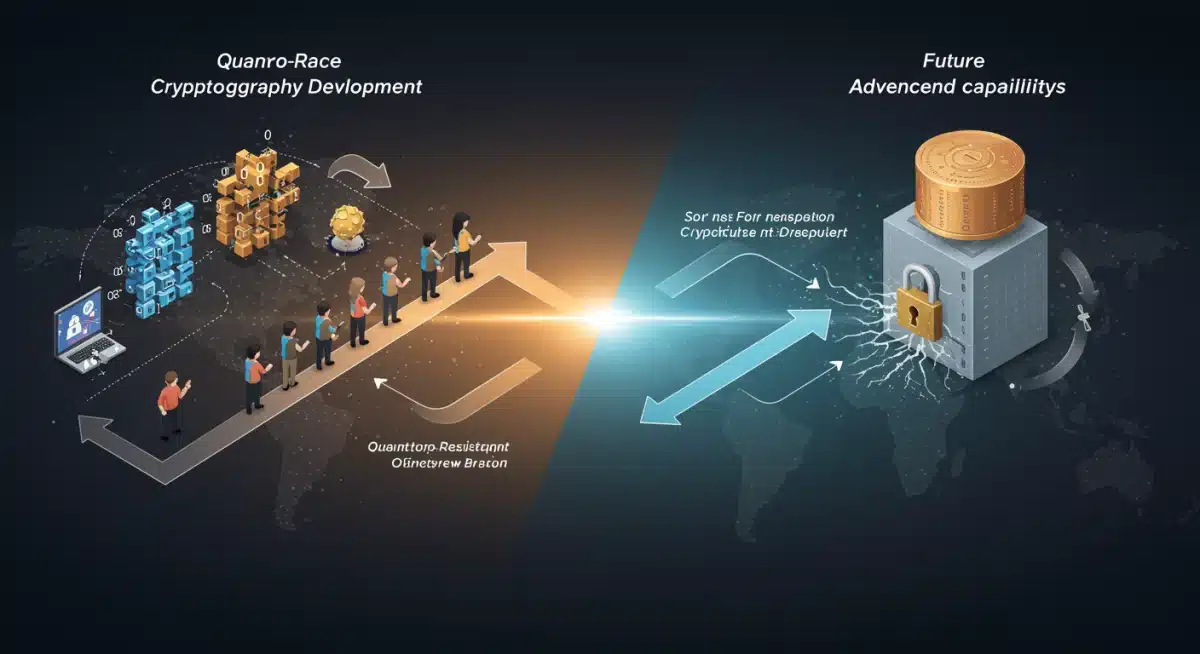
Securing Critical Infrastructure and National Security Systems
The implications of quantum computing for critical infrastructure are particularly dire. Energy grids, financial systems, transportation networks, and communication systems all rely heavily on classical encryption for their operation and security. A successful quantum attack could cripple these essential services, leading to widespread chaos and economic devastation. Therefore, a key pillar of U.S. quantum cybersecurity defense is the prioritized protection of these vital sectors.
Defense and intelligence agencies are at the forefront of this effort. Their classified networks, communications, and data are prime targets for adversaries seeking to gain a strategic advantage. The transition to PQC in these domains is already underway, albeit often under wraps. By 2026, it is expected that significant portions of the U.S. military and intelligence community’s most sensitive systems will have adopted quantum-resistant cryptographic standards.
This protection extends beyond just encryption. The integrity of supply chains for critical hardware and software components also needs to be secured against quantum-era threats. Ensuring that quantum-resistant technologies are developed, manufactured, and deployed securely, without backdoors or vulnerabilities, is paramount. This requires close collaboration between government, industry, and academia to establish trusted supply chains.
Furthermore, the U.S. must also consider the offensive capabilities that quantum computing might provide. While the focus is primarily on defense, understanding how adversaries might leverage quantum technologies for cyber warfare is crucial for developing effective countermeasures. This involves investing in quantum intelligence gathering and analysis, as well as exploring potential quantum-enabled offensive tools to better understand their impact and how to defend against them.
International Collaboration and Standard Setting
The quantum threat is a global one, transcending national borders. No single nation can effectively address it in isolation. Therefore, international collaboration is a vital component of the U.S.’s quantum cybersecurity defense strategy. Working with allies and partners to share research, develop common standards, and coordinate transition efforts will strengthen global cybersecurity resilience.
NIST’s PQC standardization process, for instance, has involved significant international participation, demonstrating a shared commitment to addressing this challenge. Establishing internationally recognized standards for PQC is crucial for interoperability and for preventing a fragmented and vulnerable global cryptographic landscape. By 2026, these international standards will begin to solidify, guiding worldwide adoption.
Beyond standardization, intelligence sharing and joint research initiatives with trusted allies are essential. Understanding the quantum capabilities of potential adversaries, sharing best practices for PQC migration, and collaborating on the development of new quantum-resistant technologies will amplify the collective defense posture. The U.S. aims to lead these efforts, fostering a global ecosystem of quantum-resilient cybersecurity.
However, international collaboration also presents challenges, particularly regarding intellectual property and technology transfer. Balancing the need for open research and shared defense with national security interests will be a delicate act. The U.S. strategy must navigate these complexities to maximize the benefits of international partnerships while safeguarding its own strategic advantages in quantum technology.
Workforce Development and Education: The Human Element
Even the most advanced technologies are ineffective without a skilled workforce to develop, implement, and manage them. The quantum revolution demands a new generation of cybersecurity professionals with expertise in quantum mechanics, cryptography, and computer science. This necessitates a significant investment in workforce development and education as a critical aspect of quantum cybersecurity defense.
Universities, research institutions, and government agencies are actively developing curricula and training programs to cultivate quantum-aware cybersecurity experts. This includes not only quantum cryptographers but also quantum engineers, quantum software developers, and policymakers who understand the implications of quantum technology. By 2026, the U.S. aims to have a growing pool of such talent to staff its national security apparatus and critical industries.
Retraining existing cybersecurity professionals is equally important. Bridging the knowledge gap between classical cryptography and PQC will be crucial for a smooth transition. This involves providing ongoing education and certification programs to ensure that the current workforce is equipped with the skills needed to implement and manage quantum-resistant solutions. The urgency of this educational push cannot be overstated, as the timeline for quantum threats is rapidly approaching.
Furthermore, public awareness and education are also vital. As quantum technologies become more prevalent, understanding their implications, both positive and negative, will be important for citizens and businesses alike. A well-informed populace can better contribute to national cybersecurity efforts and adapt to the changes brought about by the quantum era.

The Role of Quantum Computing in Offensive and Defensive Cyber Warfare
While much of the discussion around quantum computing and cybersecurity centers on its threat to current encryption, it’s also important to consider its potential role in both offensive and defensive cyber warfare capabilities. Advanced quantum computers could not only break enemy encryption but also potentially enhance existing cyberattack methods or enable entirely new forms of attack. Conversely, quantum technologies could also offer superior defensive tools.
On the offensive side, quantum algorithms might accelerate brute-force attacks, enhance malware analysis, or even be used to develop more sophisticated artificial intelligence for autonomous cyber operations. Nations with advanced quantum capabilities could gain a significant intelligence advantage, enabling them to decrypt historical communications and gain insights into long-term strategic plans. This offensive potential underscores the need for a robust and proactive quantum cybersecurity defense.
However, quantum computing also offers defensive opportunities beyond PQC and QKD. Quantum sensors, for example, could provide unprecedented precision in detecting subtle anomalies in networks, identifying stealthy cyber intrusions that classical systems might miss. Quantum machine learning, still in its nascent stages, could potentially revolutionize threat detection and anomaly identification, processing vast datasets with unparalleled speed to identify emerging cyber threats.
The U.S. strategy for 2026 involves not only defending against quantum threats but also exploring how quantum technologies can be leveraged to enhance its own cyber defense capabilities. This dual approach—defending against quantum attacks while exploring quantum-enabled defenses—is crucial for maintaining a technological edge in the evolving landscape of cyber warfare. Investment in quantum research and development across both offensive and defensive applications is thus a strategic imperative.
Challenges and Roadblocks to Quantum Cybersecurity Defense by 2026
Despite significant progress, the path to a fully quantum-resilient U.S. cybersecurity infrastructure by 2026 is fraught with challenges. One of the primary hurdles is the sheer scale and complexity of the cryptographic migration. The ‘crypto-agility’ required to seamlessly upgrade countless systems, applications, and devices is immense. Many legacy systems, particularly in critical infrastructure, are difficult and costly to update, posing significant risks if not addressed proactively.
Another challenge is the evolving nature of quantum technology itself. The exact timeline for when quantum computers will pose an existential threat to current encryption remains uncertain. This uncertainty can make it difficult to prioritize investments and allocate resources effectively. However, the ‘harvest now, decrypt later’ threat means that inaction is not an option, making a ‘no regrets’ approach to quantum cybersecurity defense essential.
Funding and resource allocation are also significant concerns. Developing and deploying quantum-resistant solutions requires substantial financial investment in research, development, infrastructure upgrades, and workforce training. Ensuring sustained funding and political will across administrations will be critical to maintaining momentum.
Finally, the threat of quantum-resistant algorithms being compromised or having unforeseen vulnerabilities is a constant concern. PQC algorithms are still relatively new, and their long-term security properties are subject to ongoing scrutiny. Continuous research, peer review, and potential updates will be necessary to ensure their resilience against future attacks, both classical and quantum. This dynamic environment requires an adaptive and flexible quantum cybersecurity defense strategy.
Conclusion: A Proactive Stance for a Secure Quantum Future
The next three years, leading up to 2026, represent a pivotal period for U.S. cybersecurity in the face of the quantum revolution. The impending threat to classical encryption demands an urgent and comprehensive response, characterized by proactive development and deployment of quantum cybersecurity defense strategies. The transition to Post-Quantum Cryptography, the strategic deployment of QKD and QRNGs, the prioritized protection of critical infrastructure, robust international collaboration, and significant investment in workforce development are all essential components of this national effort.
While challenges remain, the U.S. is demonstrating a clear commitment to securing its digital future. By embracing innovation, fostering collaboration, and investing in its human capital, the nation can navigate the complexities of the quantum era and emerge with a stronger, more resilient cybersecurity posture. The goal is not merely to react to quantum threats but to anticipate, deter, and defend against them, ensuring that the promise of quantum computing serves humanity’s progress rather than undermining its security. The journey to quantum resilience is underway, and by 2026, significant milestones must be achieved to safeguard national interests in an increasingly quantum-powered world.