The 2026 AI Landscape: 5 Emerging Trends Shaping US Businesses Now

Anúncios
The 2026 AI Landscape: 5 Emerging Trends Shaping US Businesses Now
The relentless march of artificial intelligence continues to reshape the global business landscape, with its most profound impacts often felt first in technologically advanced economies like the United States. As we cast our gaze towards 2026, it’s clear that the foundational shifts initiated by AI in recent years are accelerating, giving rise to new paradigms and unprecedented opportunities. For US businesses, understanding and strategically integrating these evolving AI capabilities is not merely an advantage but a fundamental requirement for sustained growth and competitiveness. The AI Business Trends 2026 are not abstract concepts; they are tangible forces that will dictate market leadership, operational efficiency, and customer engagement.
The pace of AI innovation is breathtaking. What was once considered speculative fiction is now becoming an everyday reality in boardrooms and on factory floors. From automating mundane tasks to generating creative content, AI’s reach is expanding, demanding a proactive and informed response from every sector. This article will delve into five pivotal emerging AI trends that are poised to significantly shape US businesses by 2026. We will explore how these trends are not only transforming existing operations but also creating entirely new business models and competitive battlegrounds. Prepare to navigate the future of enterprise with a keen understanding of the technological currents driving the next wave of innovation.
Anúncios
1. The Ascendancy of Generative AI: From Content Creation to Code Generation
Perhaps no other area of artificial intelligence has captured the public imagination and demonstrated such rapid advancement as generative AI. Tools like large language models (LLMs) and diffusion models have moved beyond novelty to become indispensable assets across a multitude of industries. By 2026, generative AI will be a cornerstone of content creation, marketing, software development, and even product design for US businesses.
The implications for content creation are immediate and profound. Marketing departments are already leveraging generative AI to draft ad copy, social media posts, blog outlines, and even entire articles, dramatically reducing time-to-market and freeing human creatives to focus on strategy and high-level conceptualization. This trend will only intensify, with AI becoming a co-pilot for marketers, enabling hyper-personalized campaigns at scale. Imagine dynamically generated landing pages tailored to individual user preferences, or video scripts customized based on real-time audience engagement data.
Anúncios
Beyond marketing, the impact on software development is equally transformative. Generative AI is increasingly assisting developers in writing, debugging, and optimizing code. This isn’t just about auto-completion; it’s about AI generating entire functions, suggesting architectural improvements, and even translating legacy code into modern languages. This significantly accelerates development cycles, lowers costs, and democratizes coding by making it more accessible. US tech companies are already integrating these tools into their workflows, leading to faster product iterations and more robust software solutions.
Furthermore, generative AI is making inroads into product design and engineering. From generating novel material compositions with desired properties to designing intricate mechanical parts, AI is proving to be a powerful ideation engine. Architects are using it to explore diverse structural designs, while designers are leveraging it to create unique visual assets and user interfaces. The creative potential unlocked by generative AI is vast, enabling businesses to innovate at an unprecedented pace and bring highly customized products and services to market.
However, the rise of generative AI also brings challenges, particularly around intellectual property, bias in generated content, and the need for robust human oversight. US businesses must develop clear policies and ethical guidelines for its use to harness its power responsibly. Investing in training employees to effectively prompt and curate AI-generated output will be crucial for maximizing its value and mitigating potential risks. The AI Business Trends 2026 clearly point towards generative AI as a core competency for any forward-thinking enterprise.
2. Ethical AI and Responsible Development: A Mandate for Trust
As AI systems become more pervasive and influential in decision-making, the focus on ethical AI and responsible development has shifted from a niche concern to a critical business imperative. By 2026, US businesses will face increasing pressure from regulators, consumers, and employees to ensure their AI systems are fair, transparent, accountable, and secure. The days of deploying AI without rigorous ethical frameworks are rapidly drawing to a close.
Concerns about algorithmic bias, data privacy, and the potential for AI to perpetuate or amplify societal inequalities are driving this trend. Consumers are becoming more aware of how AI impacts their lives, from loan approvals to job applications, and they expect companies to act responsibly. Regulators, both at federal and state levels, are beginning to introduce legislation and guidelines, such as the proposed AI Bill of Rights, to ensure AI systems are developed and deployed with human-centric values at their core. Compliance will not just be a legal necessity but a competitive differentiator.
For US businesses, this means embedding ethical considerations throughout the entire AI lifecycle, from data collection and model training to deployment and monitoring. This includes:
- Bias Detection and Mitigation: Actively identifying and addressing biases in training data and algorithms to ensure fair outcomes for all demographic groups.
- Transparency and Explainability (XAI): Developing AI systems whose decisions can be understood and explained to stakeholders, moving away from ‘black box’ models where appropriate.
- Privacy-Preserving AI: Implementing techniques like federated learning and differential privacy to protect sensitive user data while still extracting valuable insights.
- Human Oversight and Intervention: Ensuring that human beings retain ultimate control and the ability to intervene in AI-driven decisions, especially in critical applications.
- Security and Robustness: Protecting AI models from adversarial attacks and ensuring their reliability and resilience in real-world scenarios.
Building trust in AI will be paramount for its widespread adoption and acceptance. Companies that prioritize ethical AI will not only mitigate risks but also enhance their brand reputation, attract top talent, and foster deeper customer loyalty. The investment in ethical AI frameworks, specialized teams, and auditing tools will be a significant part of the AI Business Trends 2026 landscape.

3. Hyper-Personalization at Scale: The Next Frontier of Customer Experience
The era of one-size-fits-all marketing and customer service is long over. With the advancements in AI, US businesses are moving towards hyper-personalization at an unprecedented scale. This trend goes beyond simple recommendations; it involves delivering highly individualized experiences across every touchpoint, anticipating customer needs, and proactively offering tailored solutions.
By 2026, AI-powered hyper-personalization will be a key differentiator in competitive markets. Businesses will leverage sophisticated AI algorithms to analyze vast amounts of customer data—including browsing history, purchase patterns, social media interactions, and even biometric data (with consent)—to create incredibly detailed individual profiles. This deep understanding allows for real-time adjustments to product offerings, pricing, content delivery, and customer support interactions.
Consider the implications: an e-commerce site that not only recommends products based on past purchases but also dynamically reconfigures its entire layout, highlights promotions, and even adjusts pricing based on an individual’s perceived value and current context. Or a financial institution that offers personalized financial advice, predicts potential financial distress, and proactively suggests relevant products or services before a customer even realizes they need them. In healthcare, hyper-personalization could mean tailored treatment plans, drug recommendations, and preventive care strategies based on an individual’s genetic profile and lifestyle data.
The technology enabling this includes advanced machine learning models for predictive analytics, natural language processing (NLP) for understanding customer sentiment, and reinforcement learning for optimizing user interfaces and pathways. Chatbots and virtual assistants will become far more sophisticated, capable of engaging in natural, empathetic conversations and resolving complex queries without human intervention, all while maintaining a highly personalized tone and understanding historical interactions.
However, hyper-personalization demands a careful balance with privacy concerns. Businesses must be transparent about data collection and usage, offering customers clear control over their information. Companies that can master this balance—delivering unparalleled personalized experiences while upholding privacy standards—will gain a significant competitive edge in the AI Business Trends 2026 landscape. The focus will be on building trust through responsible data stewardship while maximizing customer value.
4. AI-Powered Automation and Intelligent Operations: Beyond RPA
While Robotic Process Automation (RPA) has laid the groundwork for automating repetitive tasks, the next wave of automation, driven by advanced AI, is set to revolutionize entire operational workflows. By 2026, US businesses will move beyond simply automating individual tasks to implementing intelligent, end-to-end automation solutions that can learn, adapt, and make complex decisions autonomously.
This evolution, often termed ‘Intelligent Automation’ or ‘Hyperautomation,’ integrates AI components like machine learning, natural language processing, computer vision, and predictive analytics with traditional automation tools. The goal is to create self-optimizing processes that can handle exceptions, learn from new data, and continuously improve performance without constant human intervention.
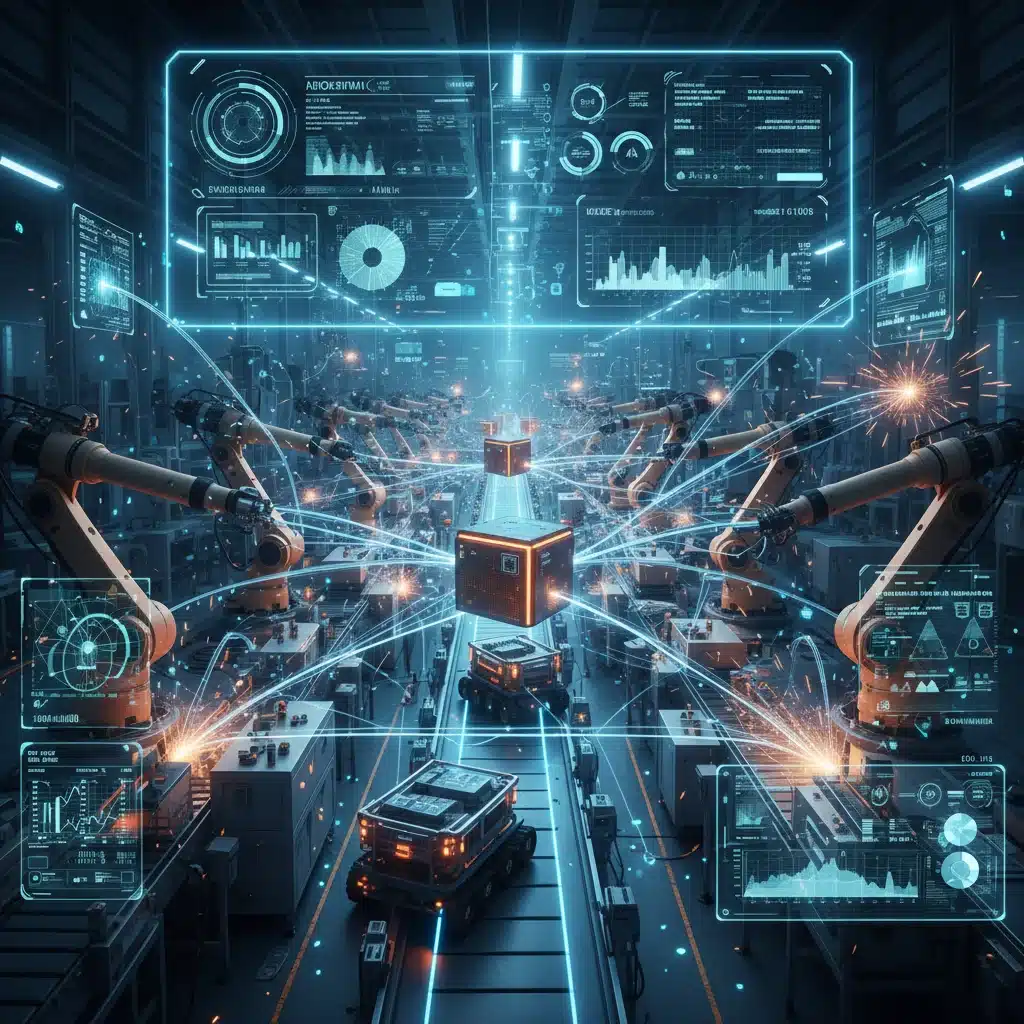
In manufacturing, AI-powered automation will extend beyond assembly lines to encompass predictive maintenance, quality control, supply chain optimization, and even generative design of new components. Robots will become more intelligent, capable of collaborating with humans, adapting to changing environments, and performing more complex, nuanced tasks. Logistics and warehousing will see further automation of inventory management, order fulfillment, and last-mile delivery, driven by AI-optimized routing and autonomous vehicles.
Back-office operations, such as finance, HR, and customer service, will also undergo significant transformation. AI will automate invoice processing, expense reporting, HR onboarding, and even parts of legal document review. Customer service centers will leverage AI to route complex queries, provide agents with real-time insights, and handle a higher volume of interactions with greater efficiency and accuracy. This doesn’t necessarily mean job displacement; rather, it means a shift in human roles towards oversight, strategic thinking, and handling highly complex or empathetic scenarios that AI cannot yet address.
Implementing intelligent automation requires a holistic approach, identifying processes ripe for transformation, integrating disparate systems, and managing change within the organization. Businesses that strategically invest in this area will unlock significant cost savings, improve operational efficiency, reduce errors, and free up human capital for more creative and high-value tasks. This is a crucial element among the AI Business Trends 2026, driving productivity and innovation across sectors.
5. The Rise of Edge AI: Processing Intelligence Where Data Lives
Traditionally, AI processing has largely occurred in centralized cloud data centers. However, a significant shift is underway towards ‘Edge AI,’ where AI computations are performed closer to the data source—on devices, sensors, and local servers at the ‘edge’ of the network. By 2026, Edge AI will be critical for US businesses requiring real-time insights, enhanced security, and reduced latency in their operations.
The drivers behind Edge AI are compelling. For applications like autonomous vehicles, industrial IoT, smart cities, and augmented reality, sending all data to the cloud for processing introduces unacceptable latency. Real-time decision-making, such as a self-driving car reacting to an obstacle or a factory machine detecting an anomaly, demands immediate local processing. Furthermore, processing data at the edge reduces bandwidth consumption, lowers cloud computing costs, and enhances data privacy and security by minimizing the need to transmit sensitive information over networks.
For US businesses, this means a proliferation of AI capabilities embedded directly into devices and local infrastructure. In retail, Edge AI will power intelligent cameras for inventory management, personalized in-store experiences, and fraud detection. In healthcare, it will enable real-time analysis of patient data from wearables and medical devices, facilitating immediate interventions and remote monitoring. Industrial sectors will use Edge AI for predictive maintenance on machinery, optimizing energy consumption, and enhancing worker safety through real-time environmental monitoring.
The challenges of Edge AI include managing distributed AI models, ensuring robust security for edge devices, and developing specialized hardware and software optimized for constrained environments. However, the benefits in terms of responsiveness, cost efficiency, and data sovereignty are too significant to ignore. Companies that can effectively deploy and manage Edge AI solutions will gain a substantial competitive advantage, particularly in industries where real-time performance and data locality are paramount. This trend represents a fundamental shift in how AI infrastructure is designed and deployed, making it a pivotal aspect of the AI Business Trends 2026.
Conclusion: Navigating the AI-Driven Future
The year 2026 promises to be a pivotal period for US businesses as they continue to grapple with and leverage the transformative power of artificial intelligence. The five emerging trends discussed—the ascendancy of generative AI, the imperative of ethical AI, the pursuit of hyper-personalization at scale, the evolution of AI-powered intelligent automation, and the rise of Edge AI—are not isolated phenomena. Instead, they are interconnected forces that collectively redefine how businesses operate, innovate, and compete.
For business leaders, the call to action is clear: staying informed about these AI Business Trends 2026 is the first step, but proactive strategy and investment are essential. This involves fostering a culture of AI literacy within the organization, investing in the right talent and technologies, and developing robust governance frameworks to ensure responsible and effective AI deployment. The competitive landscape will increasingly favor those who can not only adopt AI but also integrate it thoughtfully and ethically into their core operations.
The journey towards an AI-driven future is complex, filled with both immense opportunities and significant challenges. However, by understanding these key trends and strategically positioning themselves, US businesses can not only navigate this evolving landscape but also emerge as leaders in the next era of technological innovation. The time to prepare for 2026 and beyond is now, ensuring that AI serves as a catalyst for sustainable growth, enhanced efficiency, and unprecedented value creation.