
Practical Solutions: Implementing Zero-Trust Architecture in US Enterprises by January 2026 for Enhanced Security
In an increasingly interconnected and threat-laden digital landscape, the traditional perimeter-based security model has proven insufficient. Cyberattacks are growing in sophistication and frequency, making it imperative for organizations to adopt more robust and adaptive security frameworks. For US enterprises, the imperative to strengthen cybersecurity is particularly urgent, driven by regulatory pressures, evolving threat actors, and the increasing value of digital assets. This article delves into practical solutions for effective Zero Trust Implementation in US enterprises, aiming for a comprehensive rollout by January 2026.
The concept of Zero Trust, often summarized as ‘never trust, always verify,’ represents a fundamental shift in cybersecurity philosophy. Instead of assuming that everything inside the organization’s network is trustworthy, Zero Trust demands strict verification for every user and device attempting to access resources, regardless of their location. This proactive approach significantly reduces the attack surface and minimizes the impact of potential breaches. The journey towards a full Zero Trust Implementation is complex, requiring strategic planning, technological investment, and cultural shifts within an organization.
Anúncios
For US enterprises, the January 2026 deadline is not merely an arbitrary date but a strategic target to achieve a significant uplift in their security posture. This timeline allows for phased implementation, careful evaluation of technologies, and comprehensive training of personnel. Achieving this goal requires a clear understanding of the principles of Zero Trust, a realistic assessment of current security capabilities, and a well-defined roadmap for future development.
Understanding the Core Principles of Zero Trust
Before embarking on Zero Trust Implementation, it’s crucial to grasp its foundational principles. These principles guide the design and operation of a Zero-Trust environment:
Anúncios
- Verify Explicitly: Always authenticate and authorize based on all available data points, including user identity, location, device health, service or workload, data classification, and anomalies. No implicit trust is granted based on network location alone.
- Use Least Privilege Access: Grant users and devices the minimum access necessary to perform their tasks. This principle limits the potential damage if an account or device is compromised.
- Assume Breach: Operate under the assumption that a breach is inevitable or has already occurred. This mindset fosters a proactive approach to security, focusing on detection, containment, and response.
- Microsegmentation: Divide networks into small, isolated segments to limit lateral movement of threats. If one segment is compromised, the impact is confined.
- Multi-Factor Authentication (MFA): Enforce MFA for all access requests to add an extra layer of security beyond passwords.
- Continuous Monitoring and Validation: Continuously monitor and validate the security posture of all assets and resources. Trust is never static; it’s continuously re-evaluated.
- Automate Security: Leverage automation for policy enforcement, threat detection, and response to improve efficiency and reduce human error.
These principles form the bedrock of any successful Zero Trust Implementation, guiding organizations away from traditional, often porous, security perimeters to a more granular, identity-centric approach.
Why US Enterprises Need Zero Trust Now
The urgency for US enterprises to adopt Zero Trust is multifaceted:
Escalating Cyber Threats
Ransomware attacks, supply chain compromises, and state-sponsored cyber espionage are on the rise. Traditional security models struggle to defend against these sophisticated threats, which often bypass perimeter defenses. Zero Trust offers a more resilient defense by treating every access request with suspicion.
Remote Work and Hybrid Environments
The shift to remote and hybrid work models has blurred network boundaries. Employees access corporate resources from various locations and devices, making it challenging to secure traditional network perimeters. Zero Trust extends security controls to every access point, irrespective of location.
Regulatory Compliance
Various US regulations and frameworks, such as NIST, CMMC, and specific industry mandates (e.g., HIPAA, PCI DSS), increasingly emphasize principles aligned with Zero Trust. Proactive Zero Trust Implementation can help enterprises meet and exceed these compliance requirements, avoiding hefty penalties and reputational damage.
Data Protection and Intellectual Property
US enterprises hold vast amounts of sensitive customer data, financial information, and intellectual property. Protecting these assets is paramount. Zero Trust’s granular access controls and continuous verification significantly enhance data protection capabilities.
Key Pillars of Zero Trust Implementation
A successful Zero Trust Implementation is built upon several interconnected pillars:
1. Identity Management and Access Control (IAM)
At the heart of Zero Trust is robust identity management. This involves:
- Strong User Authentication: Implementing MFA, biometric authentication, and adaptive authentication mechanisms.
- Centralized Identity Provider: Utilizing a single source of truth for identities, such as Okta, Azure AD, or Ping Identity.
- Access Policies: Defining granular access policies based on user roles, device posture, location, and resource sensitivity.
- Privileged Access Management (PAM): Securing and monitoring privileged accounts, which are often targets for attackers.
2. Device Security and Endpoint Protection
Every device accessing corporate resources must be verified and continuously monitored. This pillar includes:
- Endpoint Detection and Response (EDR): Deploying EDR solutions to detect and respond to threats on endpoints.
- Device Posture Assessment: Continuously checking the security health of devices (e.g., up-to-date patches, antivirus status, configuration compliance) before granting access.
- Mobile Device Management (MDM) / Unified Endpoint Management (UEM): Managing and securing mobile devices and other endpoints.
- Hardware-Based Security: Leveraging trusted platform modules (TPMs) and secure boot features.
3. Network Security and Microsegmentation
Microsegmentation is a critical component of Zero Trust, limiting lateral movement. This involves:
- Software-Defined Networking (SDN): Using SDN to dynamically create and enforce segmentation policies.
- Next-Generation Firewalls (NGFWs): Deploying NGFWs with application awareness and intrusion prevention capabilities.
- Network Access Control (NAC): Controlling which devices can connect to the network based on their compliance with security policies.
- Zero Trust Network Access (ZTNA): Replacing traditional VPNs with ZTNA solutions that provide secure, least-privilege access to specific applications, not the entire network.
4. Data Security and Data Loss Prevention (DLP)
Protecting sensitive data is a primary objective of Zero Trust. Key aspects include:
- Data Classification: Categorizing data by sensitivity to apply appropriate security controls.
- Encryption: Encrypting data at rest and in transit.
- DLP Solutions: Implementing DLP to prevent unauthorized exfiltration of sensitive information.
- Cloud Access Security Brokers (CASB): Securing data accessed or stored in cloud environments.
5. Visibility, Analytics, and Automation (Security Orchestration, Automation, and Response – SOAR)
Continuous monitoring and automated response are vital for maintaining a Zero-Trust posture:
- Security Information and Event Management (SIEM): Centralizing and analyzing security logs from across the IT environment.
- User and Entity Behavior Analytics (UEBA): Detecting anomalous user and entity behavior that might indicate a compromise.
- SOAR Platforms: Automating security workflows, incident response, and policy enforcement.
- Threat Intelligence Integration: Incorporating real-time threat intelligence to inform security decisions.
A Phased Approach to Zero Trust Implementation by January 2026
Achieving a full Zero Trust Implementation by January 2026 requires a structured, phased approach. Here’s a recommended roadmap for US enterprises:
Phase 1: Assessment and Planning (Q1-Q2 2024)
This initial phase sets the foundation for the entire project.
- Current State Assessment: Conduct a thorough audit of existing IT infrastructure, security controls, applications, data, and user access patterns. Identify critical assets and potential vulnerabilities.
- Define Scope and Objectives: Clearly articulate what Zero Trust means for your organization, which assets are in scope, and measurable security objectives.
- Identify Key Stakeholders: Engage IT, security, compliance, legal, and business unit leaders. Secure executive sponsorship.
- Develop a Zero Trust Roadmap: Create a detailed plan with timelines, milestones, resource allocation, and budget. Prioritize areas for initial implementation based on risk and impact.
- Vendor Evaluation: Research and evaluate Zero-Trust-aligned technologies and vendors (e.g., ZTNA, IAM, EDR, SIEM).
- Pilot Project Identification: Select a small, non-critical segment of the organization (e.g., a specific application or department) for an initial pilot.
Phase 2: Initial Implementation and Pilot (Q3 2024 – Q1 2025)
This phase focuses on deploying foundational Zero Trust components and testing them in a controlled environment.
- Identity and Access Management (IAM) Enhancements: Strengthen MFA across the organization. Implement or refine a centralized identity provider.
- Device Posture Enforcement: Begin deploying EDR and UEM solutions. Establish policies for device health checks.
- ZTNA Pilot: Implement a ZTNA solution for a selected application or user group. Replace VPN access for this pilot group.
- Microsegmentation Planning: Start mapping network dependencies and planning for microsegmentation of critical assets.
- Security Policy Definition: Develop and refine granular access policies based on the principle of least privilege.
- Training and Awareness: Begin initial training for IT and security teams on Zero Trust principles and new tools.
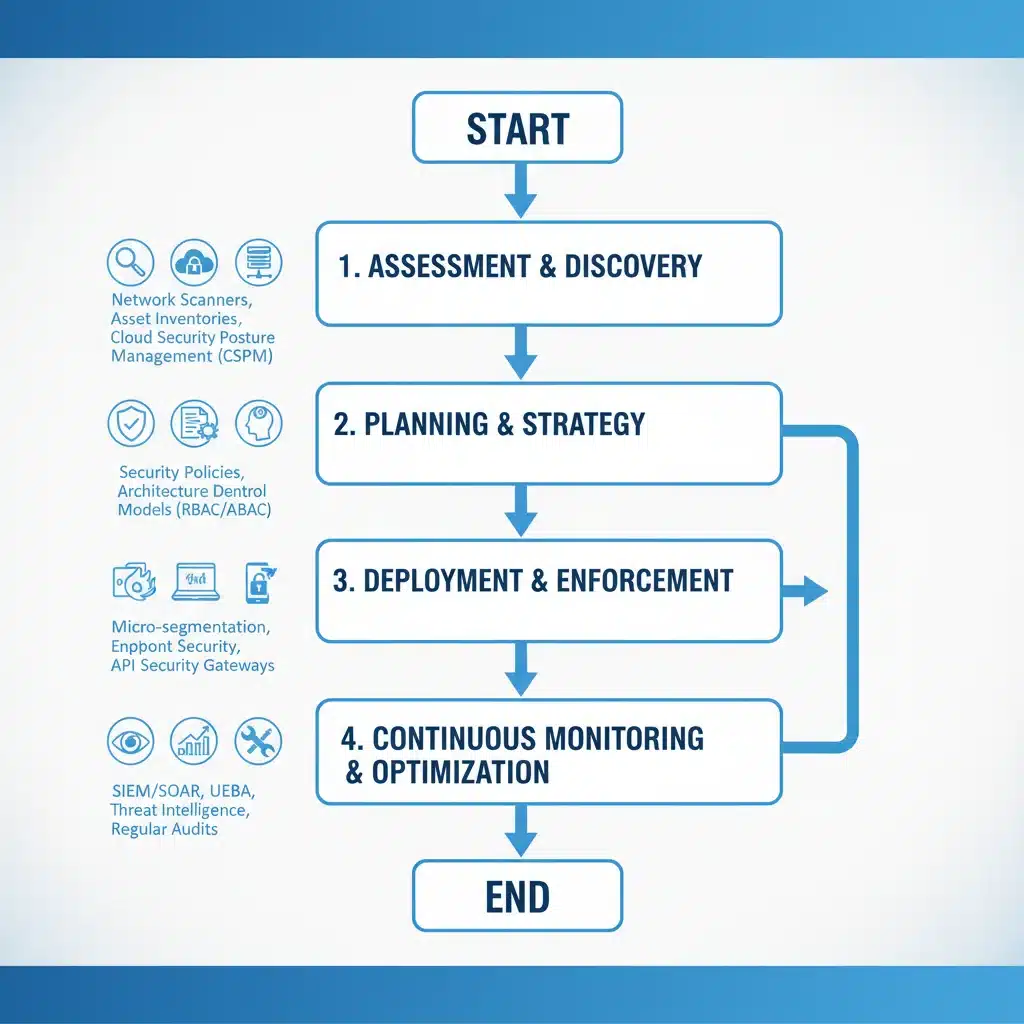
Phase 3: Phased Rollout and Expansion (Q2 2025 – Q4 2025)
Building on the success of the pilot, this phase involves expanding Zero Trust across more of the organization.
- Expand ZTNA Coverage: Gradually extend ZTNA to more applications, user groups, and remote workers.
- Implement Microsegmentation: Begin segmenting critical network resources and applications. Enforce strict traffic policies between segments.
- Data Classification and DLP: Fully implement data classification schemes and deploy DLP solutions to protect sensitive data.
- Cloud Security Integration: Extend Zero Trust principles to cloud environments, leveraging CASB and cloud native security controls.
- Automate Security Workflows: Integrate SIEM and SOAR platforms to automate threat detection, incident response, and policy enforcement.
- Continuous Monitoring Setup: Establish dashboards and reporting for continuous monitoring of security posture, access logs, and threat intelligence.
Phase 4: Optimization and Continuous Improvement (Q1 2026 and Beyond)
By January 2026, the goal is to have a robust Zero-Trust framework largely in place. This final phase focuses on refining and maturing the implementation.
- Policy Refinement: Continuously review and optimize access policies based on operational data and evolving threats.
- Threat Hunting and Red Teaming: Proactively search for threats and conduct penetration testing to identify weaknesses.
- Security Awareness Training: Ongoing training for all employees on Zero Trust concepts, phishing awareness, and secure computing practices.
- Technology Refresh and Integration: Evaluate and integrate new security technologies as they emerge. Ensure seamless integration between all Zero Trust components.
- Compliance Reporting: Regularly report on compliance with Zero Trust principles and regulatory requirements.
Challenges and Mitigation Strategies in Zero Trust Implementation
While the benefits of Zero Trust are clear, enterprises will likely encounter several challenges during Zero Trust Implementation. Proactive mitigation is key to success:
1. Legacy Systems and Technical Debt
Many US enterprises operate with a mix of modern and legacy systems that may not natively support Zero Trust principles. Integrating these older systems can be complex and costly.
- Mitigation: Prioritize modernization where possible. For legacy systems, deploy compensating controls like network segmentation gateways or application-level proxies. Isolate legacy systems and strictly control access.
2. Organizational Culture and User Adoption
Zero Trust can introduce changes to user workflows and require new habits, potentially leading to resistance.
- Mitigation: Emphasize clear communication on the ‘why’ behind Zero Trust. Provide comprehensive and ongoing training. Involve users in pilot phases to gather feedback. Design user-friendly security processes where possible.
3. Complexity and Integration
A full Zero Trust Implementation involves integrating numerous security tools and platforms, which can be complex and resource-intensive.
- Mitigation: Choose vendors with strong integration capabilities. Consider a platform approach from a single vendor or a limited set of vendors. Invest in skilled security architects and engineers.
4. Budget and Resource Constraints
Implementing Zero Trust requires significant investment in technology, personnel, and training.
- Mitigation: Develop a strong business case highlighting ROI (Reduced breach costs, improved compliance, enhanced reputation). Seek executive sponsorship for funding. Prioritize implementation based on risk, starting with the most critical assets.
5. Continuous Monitoring and Management
Zero Trust is not a one-time project but an ongoing process of monitoring, validation, and adaptation.
- Mitigation: Invest in automation tools (SOAR) and skilled security operations staff. Establish clear processes for policy review and updates. Leverage threat intelligence to stay ahead of emerging threats.

Best Practices for US Enterprises
To ensure a successful Zero Trust Implementation by January 2026, consider these best practices:
- Start Small, Scale Big: Begin with a pilot project in a controlled environment. Learn from the pilot and iterate before scaling across the enterprise.
- Focus on Critical Assets First: Prioritize protecting your most valuable data and applications. This approach provides immediate security benefits and demonstrates value.
- Embrace Automation: Automate as many security tasks as possible, from policy enforcement to incident response, to improve efficiency and reduce human error.
- Invest in Training and Talent: Ensure your security team has the necessary skills to design, implement, and manage a Zero-Trust environment. Provide ongoing security awareness training for all employees.
- Partner with Experts: If internal resources are limited, consider engaging cybersecurity consultants specializing in Zero Trust.
- Regularly Review and Adapt: The threat landscape is constantly evolving. Regularly review your Zero-Trust policies and architecture, adapting them as needed.
- Measure Success: Define clear metrics to track the effectiveness of your Zero Trust initiatives, such as reduced incident response times, fewer unauthorized access attempts, and improved compliance scores.
The Future of Enterprise Security: Beyond 2026
Achieving a robust Zero Trust Implementation by January 2026 is a significant milestone, but it’s not the end of the journey. The cybersecurity landscape will continue to evolve, with new threats and technologies constantly emerging. Enterprises must adopt a mindset of continuous improvement and adaptation.
Looking beyond 2026, we can anticipate further advancements in:
- AI and Machine Learning in Security: Increased integration of AI for predictive threat intelligence, anomaly detection, and automated response.
- Identity-Centric Security: Even more emphasis on advanced identity verification, behavioral biometrics, and decentralized identity solutions.
- Quantum-Resistant Cryptography: As quantum computing advances, the need for quantum-resistant cryptographic algorithms will become paramount.
- Supply Chain Security: Deeper integration of Zero Trust principles to secure the entire digital supply chain, including third-party vendors and partners.
- Cloud-Native Zero Trust: Continued evolution of Zero Trust specifically designed for highly dynamic cloud-native environments and serverless architectures.
Conclusion
The transition to a Zero-Trust Architecture is a transformative undertaking for US enterprises, promising significantly enhanced security and resilience against modern cyber threats. The January 2026 target for comprehensive Zero Trust Implementation is ambitious but achievable with strategic planning, dedicated resources, and a commitment to continuous improvement. By embracing the core principles of ‘never trust, always verify’ and systematically addressing the key pillars of IAM, device security, network segmentation, data protection, and robust visibility, organizations can build a security posture that is adaptable, resilient, and ready for the challenges of tomorrow’s digital world. The investment in Zero Trust today is an investment in the long-term security and operational integrity of US enterprises.